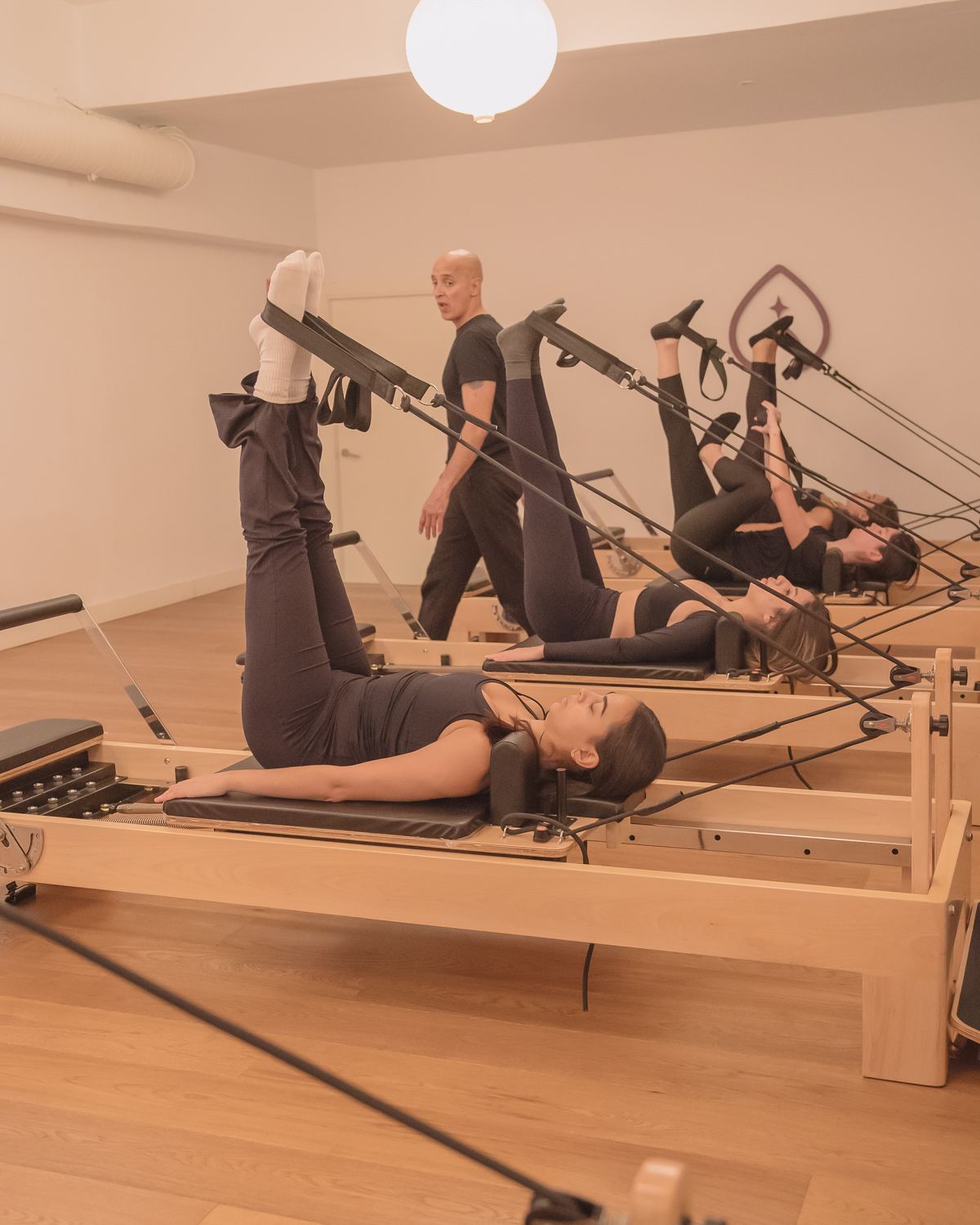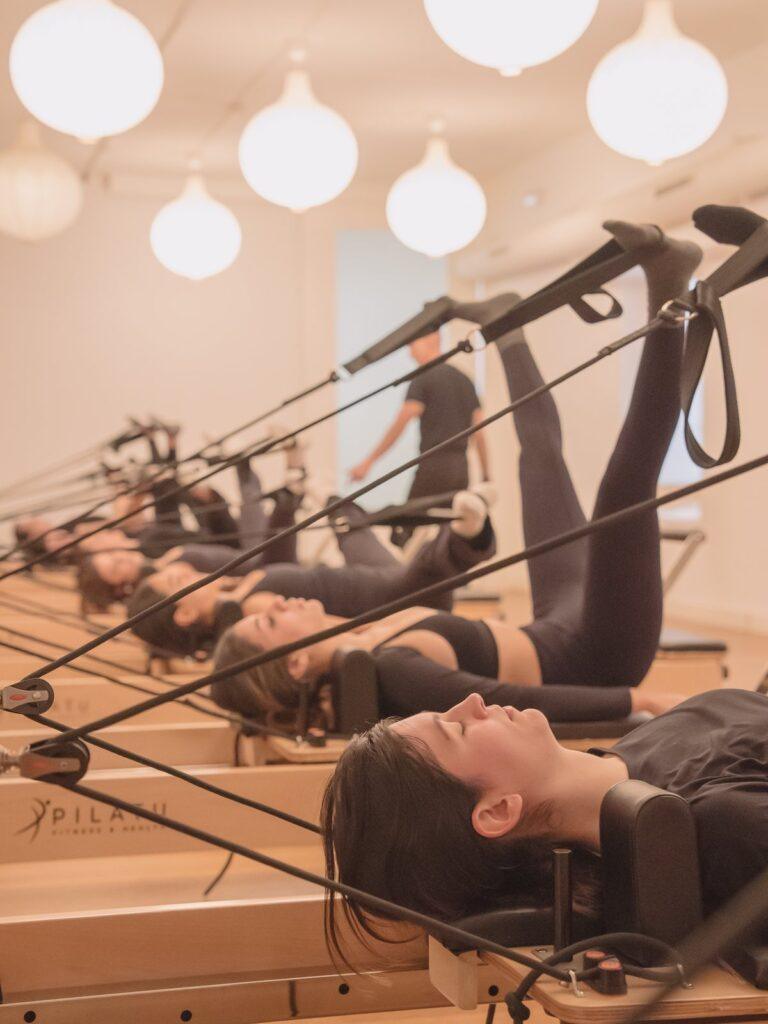
“Will I lose weight with Reformer Pilates?” It is the question we hear most from people contacting Pinar Pilates for the first time. And the honest answer is: it depends on what you mean by losing weight, on what you expect and on what else you do outside the studio.
We are not going to tell you that Reformer Pilates is a miracle solution for losing weight. Because it is not. Nor are we going to tell you it does not work. Because the scientific evidence says otherwise. What we will do is present the data as it is, without exaggerating or minimising it, so you can make an informed decision.
How Many Calories a Reformer Pilates Session Burns
Let us start with the numbers, because that is the first thing anyone who wants to lose weight looks for.
A 50-minute Reformer Pilates session burns between 200 and 450 kcal. The range is wide because it depends on several factors:
- Your body weight. A 75 kg person burns more calories than a 55 kg person doing the same exercise.
- The intensity of the class. An advanced-level class with fast transitions and heavy springs burns noticeably more than a basic-level class.
- Your fitness level. A trained body is more efficient, but it can also generate more intensity.
- The type of exercises. Series that involve the legs and core (footwork, lunges on the Reformer, long stretch) are more demanding than isolated arm exercises.
Dr Michele Olson, a researcher and Fellow of the American College of Sports Medicine (FACSM), measured energy expenditure during Pilates sessions with a metabolic cart. Her results: beginner-level sessions burn around 4 kcal per minute, intermediate sessions around 6 kcal per minute and advanced sessions reach 7.5 kcal per minute. In a 50-minute class, that translates into a range of 200 to 375 kcal.
Is that a lot or a little? Let us put it in context.
Reformer Pilates vs Other Activities: an Honest Calorie Comparison
| Activity (50 min, 65 kg person) | Estimated calories |
|---|---|
| Walking at a moderate pace | 150-200 kcal |
| Reformer Pilates (basic level) | 200-250 kcal |
| Swimming (moderate pace) | 300-400 kcal |
| Reformer Pilates (advanced level) | 350-450 kcal |
| Weight training (gym) | 250-400 kcal |
| Running (8-9 km/h) | 400-500 kcal |
| HIIT / CrossFit | 450-600 kcal |
The reality is clear: Reformer Pilates is not the activity that burns the most calories per hour. If your only goal is to maximise calorie expenditure in the shortest possible time, running or HIIT are more efficient.
But here comes the important part: the calories burned during the session are only a fraction of the story. And probably the least relevant fraction.
Why the Scales Do Not Tell the Whole Story
Most people who want to “lose weight” actually want to look and feel better. And that does not always match what the scales say.
Reformer Pilates produces something researchers call body recomposition: you reduce fat and gain muscle at the same time. Muscle is denser than fat, so it is perfectly possible for your weight to stay the same (or even rise slightly) while your body changes visibly. Your clothes fit differently. You lose centimetres. Your silhouette changes. But the scales say the same or more.
This confuses a lot of people and makes them give up. That is why it is essential to understand the difference between losing weight and changing your body composition.
Losing weight: The number on the scales going down. You can achieve it by losing fat, muscle or water. A very restrictive diet will make you lose weight, but a good part of it will be muscle, which slows your metabolism and leaves you with a weaker body.
Changing body composition: The percentage of fat going down and the percentage of muscle going up. Your body transforms even if the scales barely move. Your metabolism speeds up because muscle tissue consumes more energy at rest.
Reformer Pilates acts on the second. And the science backs it up.
What the Science Says: Real Studies on Pilates and Body Composition
We do not rely on opinions. These are the studies that support the impact of Reformer Pilates on body composition.
Study 1: Randomised clinical trial in overweight women (2025)
A study published in Scientific Reports (Nature, 2025) evaluated 47 women with overweight and obesity (BMI of 25 or higher). The experimental group did Reformer Pilates 3 times a week for 8 weeks. Results: the Reformer Pilates group showed significant improvements in body composition (reduction in fat percentage), muscle strength and psychosomatic factors compared with the control group.
Study 2: Pilates and obesity (2021 meta-analysis)
A systematic review and meta-analysis published in Frontiers in Physiology analysed multiple controlled trials and concluded that Pilates significantly reduces body weight, BMI and body fat percentage in adults with overweight and obesity.
Study 3: Body composition in obese women (2012)
A study published in the Journal of Sports Science and Medicine investigated the effects of 8 weeks of Pilates training in obese women. The results: significant reductions in weight, BMI, fat percentage, waist-to-hip ratio and basal metabolic rate.
Study 4: Muscle mass and physical performance (2021)
A study published in Sport Sciences for Health (Springer) evaluated overweight women after 8 weeks of Pilates and found significant improvements in physical performance, including core strength, muscular endurance and flexibility.
The pattern that repeats across all the studies is the same: Reformer Pilates improves body composition. It reduces fat. It increases or maintains muscle mass. And it does so progressively, safely and sustainably.
The Metabolic Effect: How Muscle Burns Calories without You Doing Anything
Here is the most powerful argument in favour of Reformer Pilates for long-term fat loss.
Every kilogram of muscle you gain consumes between 13 and 20 kcal a day just by existing. Fat, on the other hand, consumes between 4 and 5 kcal per kilogram. It seems a small difference, but it adds up.
If over 6 months of consistent Reformer Pilates you gain 2-3 kg of muscle (a realistic figure according to the studies), your basal metabolic rate increases by between 26 and 60 kcal a day. That is between 9,500 and 22,000 additional kcal a year burned without doing anything. The equivalent of 1-2.5 kg of fat that your body consumes automatically.
This effect does not show up in the session. The heart-rate monitor does not measure it. But it works 24 hours a day, 365 days a year. And it is cumulative: the longer you have been practising, the greater the effect.
Dr Olson’s research observed that consistent Pilates practice can measurably raise the basal metabolic rate. Muscle does not only change your appearance: it changes how your body manages energy at rest.
What Reformer Pilates CAN and CANNOT Do for Your Weight
Let us be direct. This is the most important section of the article.
What it CAN do:
- Improve your body composition. Less fat, more muscle. Your body changes even if the scales do not move much.
- Raise your basal metabolic rate. More muscle means more calories burned at rest, every day.
- Tone and define your figure. The Reformer works deep and superficial muscles, which produces a firmer, more defined appearance.
- Reduce centimetres. Several studies show significant reductions in waist circumference and waist-to-hip ratio.
- Improve your relationship with your body. The body awareness you develop on the Reformer changes how you feel and how you move.
- Complement a healthy diet perfectly. Reformer Pilates and a balanced diet make a very effective team.
What it CANNOT do:
- Make up for a poor diet. If you consume 3,000 kcal a day and your body needs 1,800, no amount of Pilates will create a sufficient calorie deficit.
- Produce fast, drastic weight loss. You are not going to lose 5 kg in a month with Pilates alone. If someone promises you that, be suspicious.
- Replace cardiovascular exercise for heart health. Reformer Pilates improves body composition, but for cardiovascular health it is advisable to complement it with aerobic activity (walking, swimming, cycling).
- Work without consistency. One class a week brings mobility and wellbeing benefits, but for significant changes in body composition you need at least 2-3 sessions a week.
Why Consistency Matters More than Intensity
Many people look for the workout that burns the most calories per minute. They choose HIIT, CrossFit or high-pace running. And for a few weeks, it works. But then something predictable happens: they get injured, they burn out or they simply stop going because they do not enjoy it.
Research on exercise adherence shows that the factor that best predicts long-term results is not the intensity of the training, but the ability to keep it up over time.
And here Reformer Pilates has a real advantage. According to a review of studies published in Complementary Therapies in Medicine, Pilates has higher adherence rates than other forms of exercise, particularly among women and middle-aged people. There are several reasons:
- Low joint impact. It does not wreck your knees or your back. You can practise it for years without accumulating wear.
- Constant progression. There is always another level: heavier springs, more complex exercises, smoother transitions.
- Community. Small groups (at Pinar Pilates a maximum of 8 people) create bonds that increase commitment.
- Immediate sense of wellbeing. You leave every class feeling better than when you walked in. That reinforces the habit.
What use is a workout that burns 600 kcal if you only do it for 3 weeks before giving up? A workout that burns 300 kcal but that you do consistently for 12 months produces incomparably better results.
The studies confirm it. The 2025 clinical trial in Scientific Reports obtained significant results with only 3 Reformer Pilates sessions a week for 8 weeks. It was not necessary to train to the limit. It was necessary to be consistent.
How to Maximise Fat Loss with Reformer Pilates
If your goal is to lose fat in a real, sustainable way, this is the combination the evidence supports:
1. Practise Reformer Pilates at least 2-3 times a week. It is the minimum for generating significant changes in body composition. The studies that show results use frequencies of 2-3 sessions a week.
2. Combine it with moderate aerobic activity. Walk 30-45 minutes a day, swim or cycle. You do not need to run marathons. Consistent daily movement has a huge impact on total calorie expenditure.
3. Look after your diet. It is not about extreme diets. It is about eating enough protein to maintain muscle, prioritising real food and keeping a moderate calorie deficit if you want to lose fat. A nutritionist can help you personalise this.
4. Do not obsess over the scales. Take photos, measure centimetres, notice how your clothes fit. Those indicators reflect real changes far better than weight.
5. Be patient. Real changes in body composition take between 8 and 12 weeks to become visible. The scientific studies work with periods of at least 8 weeks. Do not expect results in 2 weeks.
Pilates for Weight Loss in Madrid: Why Pinar Pilates?
If you have read this far, you are probably wondering whether Reformer Pilates fits into your plan to change your body. Here is why Pinar Pilates is a good starting point.
Groups of a maximum of 8 people. This is no minor detail. For Reformer Pilates to produce real results, the technique has to be correct. With 8 people per class, our instructors can observe and correct each student in every exercise. In classes of 15-20 people, that is impossible.
Classes that progress with you. Not all classes are the same. We differentiate levels so you always work at the right intensity. If you are a beginner, you will start with a solid foundation. If you already have experience, we will challenge you to keep progressing.
Central location. Our studio is at Calle del Pinar 8, in the Salamanca district (28006, Madrid). Accessible and no excuses.
Real ratings. 4.9 out of 5 on Google with more than 490 reviews. That is not marketing: they are the opinions of real students who have been coming for months or years.
Prices adapted to different frequencies. Because consistency matters, we offer packs that make it easier to keep up the routine:
- 4-class pack: 100 euros/month
- 8-class pack: 150 euros/month
- 12-class pack: 200 euros/month
- Unlimited plan: 250 euros/month
- Single class: 30 euros
See all the details on our prices page.
Is Reformer Pilates Enough to Lose Weight?
The most accurate answer: it is a fundamental piece, but not the only one.
Reformer Pilates improves your body composition, raises your basal metabolic rate, tones your body and teaches you to move better. The science backs it up with clinical trials and meta-analyses published in leading journals. Its benefits go far beyond weight: posture, flexibility, functional strength, mental wellbeing.
But if you want to lose a significant amount of fat, you also need to look after your diet and stay active outside the studio. That is something no exercise class, however good, can replace.
What Reformer Pilates can do is be the central axis of an active, healthy lifestyle. The kind of exercise you enjoy, that does not injure you, that makes you feel good after every session and that you can keep up for years. And that consistency is, according to all the evidence, the factor that best predicts real results.
If you are curious to try, you do not need to commit long term. You can start with a single class and decide from there. If you are comparing Reformer Pilates with the traditional gym for your goals, we recommend reading our detailed comparison.
Book your first class with 50% off and see what the Reformer can do for your body. No commitments and no false promises.
Pinar Pilates. Calle del Pinar 8, Salamanca district, 28006 Madrid. Tel: +34 611 994 729. Reformer Pilates in small groups of a maximum of 8 people.
Pinar Pilates · Salamanca district, Madrid
Your first reformer class, €15
Groups of 8 people maximum, specialist instructors and more than 40 classes a week. Your first class is half price.
Book my first classCalle del Pinar 8, Madrid · Questions? Message us on WhatsApp