Reformer Pilates and swimming are two of the physical activities with the best reputation when it comes to looking after the body without punishing it. Neither pounds the joints, both work the body globally, and both have a solid base in the scientific literature on rehabilitation and wellbeing.
Even so, they are not interchangeable. They follow completely different movement logics, take place in different environments, activate the muscles in opposite ways and have advantages and drawbacks that depend on who you are, what injuries you have and what you are looking for.
This comparison is not going to tell you that one is better than the other. What it will do is explain the real differences so you can choose with judgement, or decide whether you would like to combine them.
What Sets Reformer Pilates Apart from Swimming
The environment and the load on the body
Swimming takes place in water. Water reduces apparent body weight by 70% to 90% depending on the depth of immersion, which relieves pressure on the joints and the intervertebral discs. It is, by definition, an activity with very low joint impact.
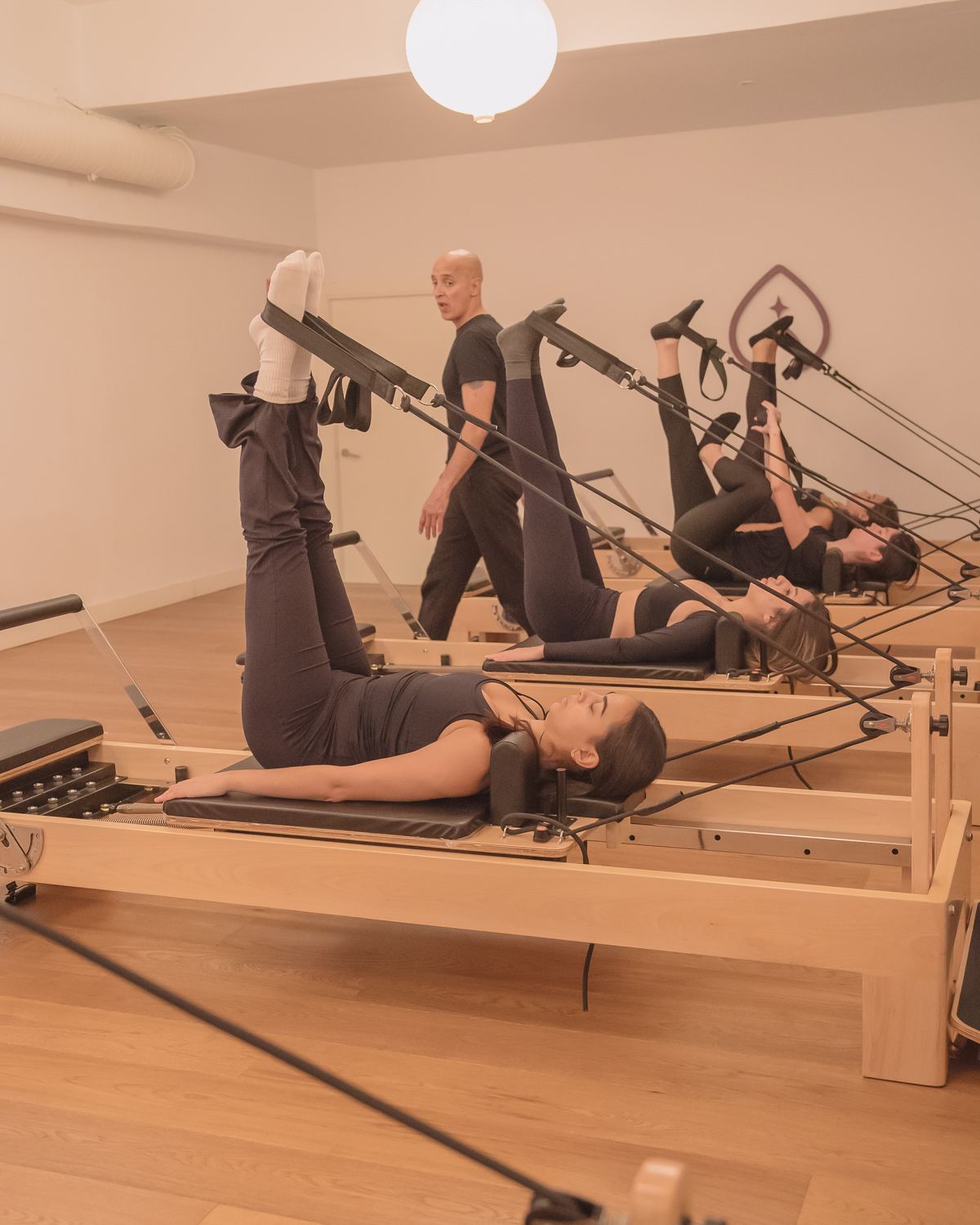
Reformer Pilates works on dry land, but uses a system of springs and pulleys that lets the resistance be modulated with great precision. There is no joint impact because there are no jumps or blows, and the instructor can adjust the load according to each person’s condition. This makes the Reformer a tool for fine control of movement that the pool cannot offer.
Muscle activation patterns
Swimming activates large muscle groups rhythmically and repetitively: lats, trapezius, pectorals, glutes, hamstrings and quads. Propulsion is generated mainly from the shoulders and the hips. Core work exists, but it is more of a secondary stabilising role than a main focus of the training.
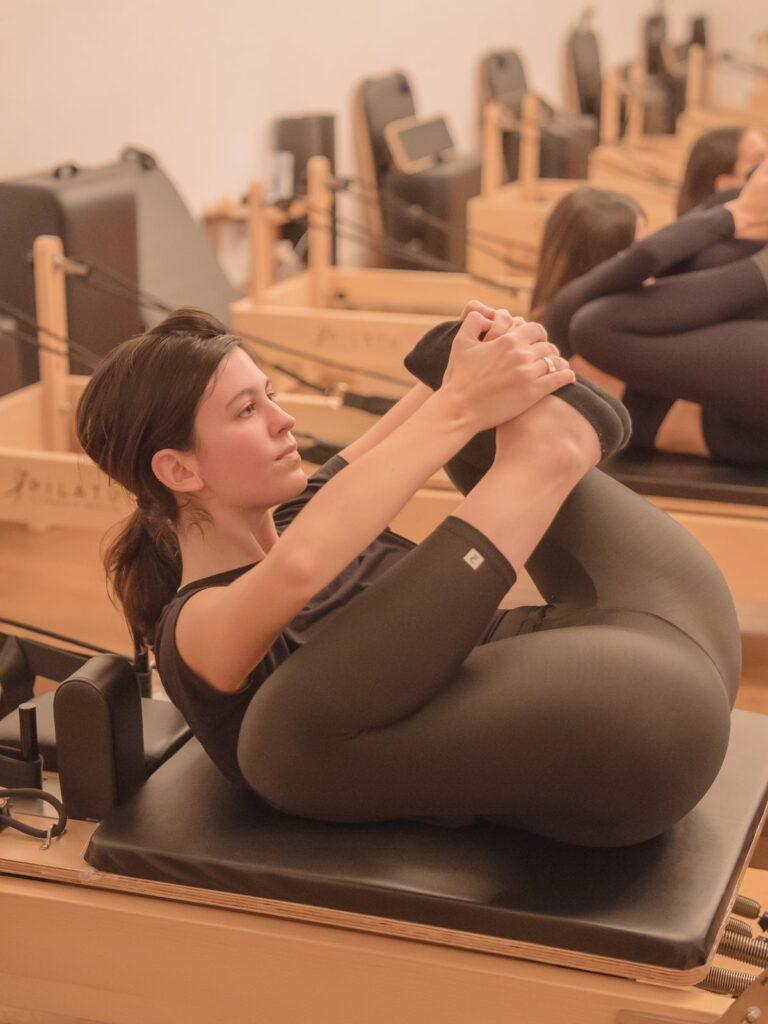
Reformer Pilates puts the core at the centre of every exercise. Activation of the transversus abdominis, the multifidus and the pelvic floor is continuous and conscious. The movement patterns are slower, more controlled and more varied than those of swimming, which makes it possible to work specific muscle imbalances that the pool cannot address.
The load on the spine
Here lies one of the most important and least discussed differences. Swimming is done with the spine horizontal, which reduces vertical compressive load. But that does not mean the spine is free of tension. Depending on the stroke and technique, some strokes can create specific problems that we look at further on.
Reformer Pilates works the spine actively, mobilising it in all its planes of movement, with constant attention to alignment and to activation of the stabilising muscles. This makes it a more precise tool for treating spinal dysfunction.
The social component and supervision
Swimming is, in most cases, a solitary activity. You swim in your lane, at your own pace, with nobody correcting your technique or designing a programme adapted to your needs. You can sign up for courses or synchronised swimming groups, but in everyday use it is an individual sport.
At Pinar Pilates, Reformer classes have a maximum of 8 people. That is not marketing: it is the condition that lets the instructor see every student, correct in real time and adapt the exercises to each body. If you have an active injury, that supervision is the difference between improving and making the problem worse.
Comparison Table: Reformer Pilates vs Swimming
| Criterion | Reformer Pilates | Swimming |
|---|---|---|
| Joint impact | Very low | Very low |
| Back pain relief | High (targeted work) | Moderate (depends on stroke) |
| Joint-friendliness | Very high | Very high |
| Core activation | Very high and conscious | Moderate and secondary |
| Flexibility gains | High (active joint mobility) | Moderate |
| Cardiovascular component | Low-moderate | High |
| Monthly cost | €100-250 (supervised classes) | €30-60 (pool membership) |
| Convenience and access | Needs an equipped studio | Needs a pool |
| Technical supervision | Constant (instructor present) | None in free swimming |
| Learning curve | Moderate (manageable in a few sessions) | High (complex technique per stroke) |
Swimming or Pilates for Back Pain: Which Works Better
This is the question that most often leads people to compare these two activities. And the honest answer is: it depends on the origin of the pain and on the stroke.
Why Reformer Pilates offers more control over the spine
The Reformer lets you work the spine in all its planes of movement in a controlled, progressive way. Flexion, extension and rotation exercises are specifically designed to mobilise stiff segments, strengthen the stabilising muscles and reduce the compensation patterns that keep pain going.
If you have a herniated disc, spinal stenosis or an episode of acute low back pain, a trained instructor can design a session that respects your limitations and, at the same time, moves you towards recovery. That possibility does not exist in the pool.
To learn more about how the Reformer specifically addresses lower back and neck pain, see our articles on back pain and neck pain.
The biomechanical problems of some swimming strokes
Not all swimming strokes are the same. Some involve movement patterns that can aggravate existing problems in the spine or shoulders.
Breaststroke and butterfly. Breaststroke demands repeated lumbar extension in every stroke cycle. In people with facet joint problems or lumbar stenosis, that continued extension can irritate the tissues and increase pain. Butterfly amplifies this problem: it is the stroke that puts the most stress on the lumbar spine of all, and it requires a core strength that few people have properly developed before practising it.
Front crawl and the shoulder. Front crawl is the most popular stroke and generally the least aggressive for the spine. However, the repetitive movement of the shoulder in internal rotation with the arm extended can cause subacromial impingement syndrome if the technique is not correct or if there is an imbalance in the rotator cuff muscles. This is one of the reasons many frequent swimmers end up with shoulder problems.
Backstroke. Backstroke is the safest option for people with lumbar problems, since it avoids forced extension. However, it can be uncomfortable for those with neck problems because of the neck position.
Who Should Choose Each Option
Choose Reformer Pilates if…
- You have active back pain, whether lumbar, thoracic or cervical.
- You are in rehabilitation after an injury or surgery.
- You want to improve posture and work on muscle imbalances specifically.
- You want to strengthen the pelvic floor and the deep abdominal muscles.
- You prefer supervised sessions where someone checks your technique.
- You are interested in results in mobility, stability and quality of movement.
If you are new to the Reformer, the article on the first Reformer Pilates class in Madrid explains what to expect and how to prepare.
Choose swimming if…
- You want low-impact cardiovascular training to burn calories steadily.
- It is hot in summer and water is your preferred environment.
- You have no active injuries that need individual attention.
- You enjoy the solitude and the meditative rhythm of swimming in a lane.
- You want to build aerobic endurance without the wear of running.
Consider doing both if…
- You swim frequently and want to offset the muscle imbalances it creates.
- You are a runner or an athlete and need a low-impact complement that strengthens your core.
- You have a general improvement goal that includes both aerobic endurance and functional strength.
Pilates and Swimming as Complements: A Combination That Works
The two disciplines do not compete: they complement each other well when used intelligently.
Reformer Pilates can act as preparation for a swimming session. A session of shoulder mobility, chest opening and core activation before getting in the water can improve swimming efficiency and reduce the risk of injury. Breaststroke, for example, demands a hip opening and thoracic mobility that the Reformer develops better than any conventional dry warm-up.
In the other direction, Pilates can work the specific weaknesses that swimming does not touch. Swimmers usually have a highly developed upper back but a relatively weak deep core and pelvic floor. The Reformer can balance that pattern.
A reasonable frequency for someone combining both activities might be two Reformer sessions and two or three swimming sessions a week, adjusted for intensity and goals. To learn in more detail how to structure your weekly frequency, see the article on how many times a week to practise Pilates.
Frequently Asked Questions
Does Reformer Pilates help you swim better?
Indirectly, yes. The Reformer develops thoracic mobility, shoulder stability, core activation and body awareness, qualities that improve technical efficiency in the water. It does not replace pool training, but it improves the physical base on which swimming technique is built.
Can I do Reformer Pilates if I have a shoulder injury from swimming?
In most cases, yes, as long as the instructor knows about the injury and adapts the exercises. The Reformer is precisely one of the best environments for rehabilitating the shoulder because it lets you control resistance and range of movement very precisely. Tell the instructor before you start.
Does swimming help low back pain or can it make it worse?
It depends on the stroke and the technique. Front crawl and backstroke are generally safe for the lower back. Breaststroke and butterfly can aggravate facet joint problems or lumbar stenosis because of the repeated extension. If you have low back pain and want to swim, consult a professional before choosing a stroke.
Is Reformer Pilates more expensive than swimming?
In terms of monthly cost, yes. A municipal pool in Madrid costs between €30 and €60 a month. Supervised Reformer classes cost more because they include specialist equipment, small groups and personal attention. At Pinar Pilates, the 4-class plan costs €100 and unlimited access is €250 a month. The price difference reflects a real difference in the type of service.
How long does it take to notice the effect of Reformer Pilates for someone coming from swimming?
People who come from swimming usually have good cardiovascular capacity and a certain strength base in the back and shoulders. What they notice first are the changes in the deep abdominal muscles, better hip mobility and less neck tension. In general, with one or two sessions a week, the changes start to become noticeable between the fourth and eighth week.
Reformer Pilates in the Salamanca District
Pinar Pilates, at Calle del Pinar 8 (Madrid), offers Reformer classes in groups of 8 people maximum and more than 40 classes a week. More than 490 Google reviews (average 4.9 out of 5) vouch for the quality of the work.
The prices available are:
- First class: €15 (50% off)
- Drop-in class: €30
- 4-class plan: €100
- 8-class plan: €150
- 12-class plan: €200
- Unlimited plan: €250 a month
For any questions, call us on +34 611 994 729.
Book your first class at 50% off
Pinar Pilates · Salamanca district, Madrid
Your first reformer class, €15
Groups of 8 people maximum, specialist instructors and more than 40 classes a week. Your first class is half price.
Book my first classCalle del Pinar 8, Madrid · Questions? Message us on WhatsApp