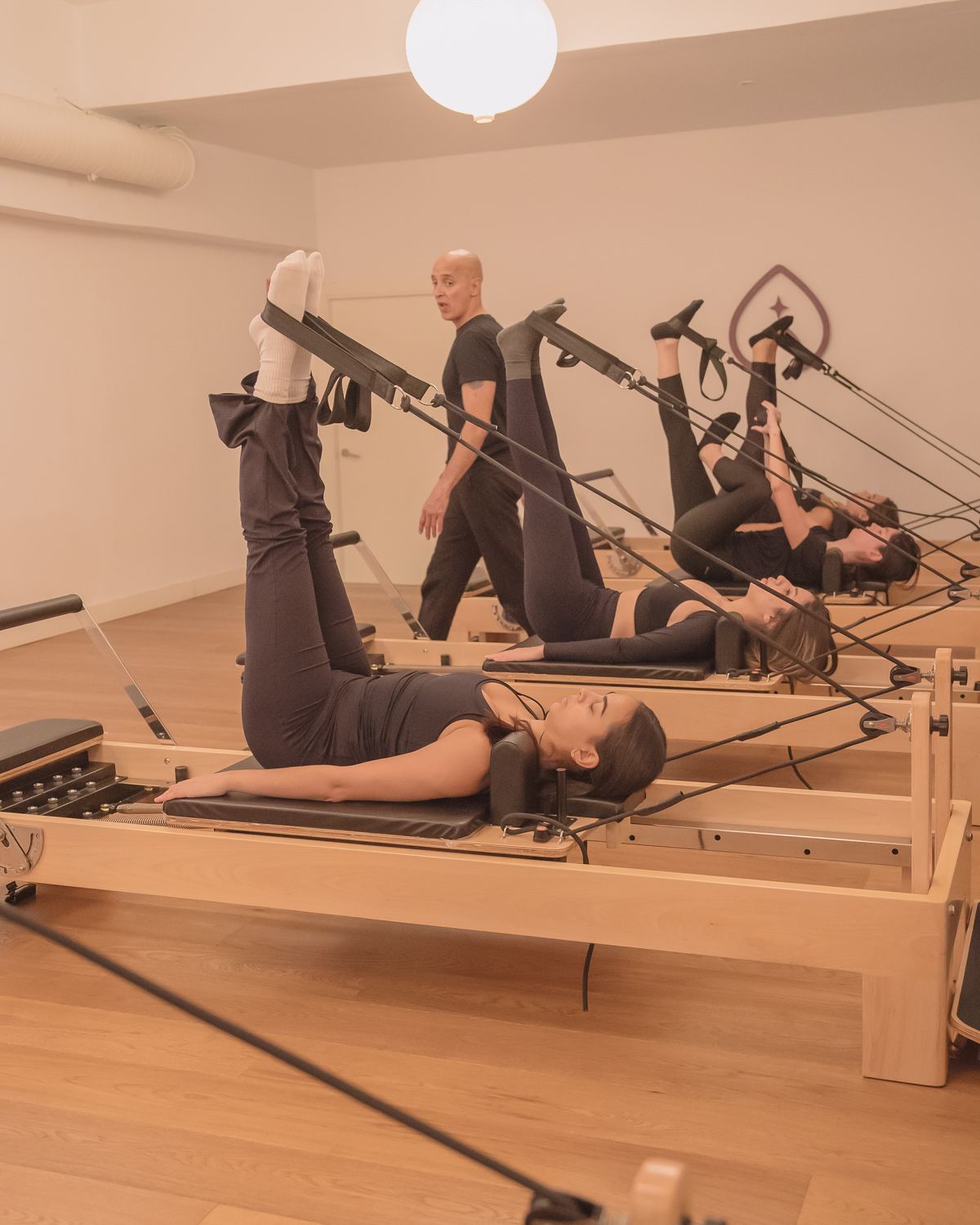
Running is the most accessible sport in the world. You put on your trainers, walk out the door and off you go. That simplicity is its greatest virtue and, at the same time, its biggest trap. Because running is a repetitive movement that places the same loads on the same structures, kilometre after kilometre, session after session, year after year. And when the body is not prepared to absorb those loads, injuries appear.
The figures confirm it. According to a systematic review by van Gent et al. (2007), published in the British Journal of Sports Medicine, the annual incidence of injuries in recreational runners ranges from 19.4% to 79.3%, depending on the definition used. The most affected areas are the knee, the shin, the foot and the hip. Most of these injuries are not traumatic: they are the consequence of muscle imbalances, accumulated weaknesses and inefficient movement patterns.
Reformer Pilates corrects exactly that. It is not a substitute for running, but the complement your body needs to withstand the impact without breaking down. In this article we explain the most common imbalances in runners, how the Reformer corrects them, what the science says about cross-training for injury prevention and which specific exercises you should add to your routine.
The Imbalances Every Runner Carries
Running is a movement in the sagittal plane (forwards and backwards) that always recruits the same muscle groups. What is not used gets weaker. What is overused gets shorter. The result is a body with predictable imbalances that, over time, turn into injuries.
Weak Glutes: Where It All Starts
The gluteus medius is the main lateral stabiliser of the pelvis during the single-leg stance phase (when all your weight is on one leg, which happens with every stride). When the gluteus medius is weak, the pelvis drops towards the opposite side (Trendelenburg sign). That pelvic drop sets off a cascade of compensations: the knee collapses inwards (dynamic valgus), the tibia rotates internally and the foot over-pronates.
Fredericson et al. (2000) published in the Clinical Journal of Sport Medicine a study showing that runners with iliotibial band syndrome had significant weakness of the gluteus medius on the affected leg. After a specific 6-week strengthening programme, 92% of the runners were able to run pain-free again.
Shortened Hip Flexors
The hip flexors (iliopsoas and rectus femoris) work constantly while running, lifting the knee with every stride. That repeated use shortens them. A shortened psoas pulls the lumbar spine into hyperlordosis, limits hip extension during the push-off phase and reduces stride length. The result: more load on the lower back, lower biomechanical efficiency and a higher risk of low back pain.
Iliotibial Band Syndrome
The iliotibial band (IT band) is a fascial structure that runs down the outside of the thigh, from the hip to the knee. When the glutes do not stabilise the pelvis properly and the tensor fasciae latae compensates, the IT band tightens and rubs against the lateral epicondyle of the femur. The resulting pain on the outside of the knee is one of the most common injuries in middle- and long-distance runners.
An Insufficient Core
The core is not only about showing off your abs. In running, the deep muscles of the trunk (transversus abdominis, multifidus, pelvic floor, diaphragm) stabilise the pelvis and the spine while the limbs move at high speed. A weak core causes lateral trunk sway, excessive pelvic rotation and energy loss with every stride. Sato and Mokha (2009), in the Journal of Strength and Conditioning Research, showed that a 6-week core stabilisation programme improved 5,000-metre times in recreational runners.
Reduced Thoracic Mobility
Runners tend to adopt a stooped posture: rounded shoulders, a stiff thoracic spine. That lack of thoracic mobility limits trunk rotation while running, which reduces the efficiency of the arm swing and forces the lower back and neck to compensate. Postural correction on the Reformer addresses this problem directly, as we explain in our article on improving posture with Reformer Pilates.
How Reformer Pilates Corrects These Imbalances
The Reformer is not a conventional weight machine. Its variable-resistance spring system, sliding carriage and straps let you work strength, mobility and neuromuscular control in a single exercise. For a runner, this means three fundamental things.
Frontal-Plane and Rotational Work
Running happens essentially in the sagittal plane. The Reformer forces the body to work in planes that running ignores: lateral movements, rotations, single-leg stabilisation. This balances the muscles and reduces the risk of overuse injuries.
Eccentric Strengthening
The Reformer springs generate resistance that has to be controlled both in the push phase (concentric) and in the return phase (eccentric). Eccentric work is especially relevant for runners because the shock-absorption phase of every stride is, by definition, an eccentric contraction. Strengthening the muscles in that phase reduces the risk of tendinopathies and muscle injuries.
Mobility with Control
The Reformer lets you gain range of movement under resistance, not simply by stretching passively. It trains functional flexibility: the ability to access a joint range while keeping muscular control. For a runner, this means more hip extension without losing pelvic stability, more ankle dorsiflexion without the arch of the foot collapsing.
What the Science Says about Cross-Training and Injury Prevention
The evidence for cross-training as an injury prevention strategy in runners is consistent.
Lauersen, Bertelsen and Andersen (2014) published in the British Journal of Sports Medicine a meta-analysis of 25 trials (26,610 participants) that assessed the effect of different types of exercise on preventing sports injuries. Strength training reduced overuse injuries by more than 50%. The authors concluded that strength programmes are the most effective intervention for injury prevention in athletes.
Wells et al. (2014), in a review published in PLOS ONE, confirmed that Pilates produces significant improvements in pain, function and quality of life, which makes it a valid tool for recovery and prevention in active populations.
A study by Finatto et al. (2018), published in Sports Medicine, showed that strength training improves running economy (the amount of oxygen needed to hold a given pace) in distance runners. More efficient runners use less energy at the same speed, which translates into better times and less fatigue.
Reformer Pilates combines muscle strengthening, neuromuscular control and joint mobility in every session. For a runner who already spends several hours a week running, adding 1 or 2 Reformer sessions is the smartest way to invest their complementary training time.
6 Reformer Exercises for Runners
These exercises are part of the repertoire we use at Pinar Pilates with our students who run. In our classes of 8 people maximum, the instructors can adapt the resistance and complexity of each exercise to the level and needs of each runner.
1. Single Leg Footwork
Position: lying on your back on the carriage, one foot on the bar, the other leg in table top (hip and knee at 90 degrees).
Execution: push the bar with one foot, extending the leg and sliding the carriage. Control the return without letting the spring pull the carriage back. Keep the pelvis completely stable, with no rotation or tilt.
Why it works for runners: it reproduces the push-off phase of running (single-leg support) while demanding pelvic stabilisation. It strengthens quads, glutes and hamstrings unilaterally, detecting and correcting asymmetries between the right and left leg.
2. Side Lying Hip Work
Position: lying on your side on the carriage, the foot of the top leg in the strap, hip and trunk aligned.
Execution: lift the leg against the spring resistance in abduction, keeping the pelvis stable. Variations: hip circles, flexion-extension in abduction, pulses at different angles.
Why it works for runners: it strengthens the gluteus medius in isolation and specifically. It is the most direct exercise for correcting the weakness that causes dynamic knee valgus and iliotibial band syndrome.
3. Knee Stretch Series
Position: kneeling on the carriage, hands on the bar, back in neutral (or rounded, depending on the variation).
Execution: push the carriage back by extending the hips, keeping the arms fixed on the bar. Control the return. The “round back” variation emphasises core activation; the “flat back” variation emphasises the posterior chain.
Why it works for runners: it works glutes, hamstrings and core in a movement pattern that mimics the push-off phase of running. The round back version is excellent for runners with excessive lumbar lordosis caused by shortened hip flexors.
4. Hip Flexor Stretch on the Reformer
Position: one knee on the carriage, the other foot on the floor beside the Reformer (half-kneeling position). Hands on the bar or on the shoulder rest.
Execution: let the carriage glide gently backwards, deepening the stretch of the psoas and rectus femoris of the leg on the carriage. Keep the pelvis neutral, avoiding lumbar hyperlordosis.
Why it works for runners: it stretches the hip flexors under control, with the spring assisting the movement. Unlike static stretching on the floor, the Reformer lets you grade the intensity precisely and work hip mobility without lumbar compensations.
5. Running on the Reformer
Position: lying on your back, the ball of one foot on the bar, the other leg raised.
Execution: alternate the feet on the bar rhythmically, mimicking the running pattern. Each change includes a plantar flexion of the foot that leaves and a dorsiflexion of the foot that lands.
Why it works for runners: it improves coordination of ankle and foot movement, strengthens the calves and the soleus (fundamental for shock absorption) and trains the transition between stance and flight. All with the spine fully unloaded.
6. Side Splits (Standing)
Position: standing on the Reformer, one foot on the carriage and the other on the fixed platform. Arms out to the sides or on the hips.
Execution: let the carriage open sideways, controlling the opening with the adductors and the gluteus medius. Return to centre with control. Keep the trunk upright and the pelvis level.
Why it works for runners: it strengthens adductors and abductors through a wide range of movement. The adductors are pelvic stabilisers that get little work in running. The exercise also challenges standing balance and proprioception, which transfers directly to running.
Running in Madrid: Your Body Needs More than Kilometres
Madrid is an extraordinary city for running. Retiro Park, with its 125 hectares of shaded paths, is the favourite option for a midweek session. Casa de Campo offers longer routes, with climbs and varied terrain that test any runner. Madrid Río adds kilometres of paved track along the Manzanares. And every spring, the Madrid Marathon brings thousands of runners onto the streets of the capital.
Madrid’s running community grows every year. Running clubs, meet-ups in Retiro on Saturday mornings, marathon training groups. But that same passion leads many runners to pile on volume without working on the foundations they need to support it. The result: plantar fasciitis at 500 kilometres, runner’s knee before the first half marathon, Achilles tendinopathy that forces a stop in the middle of a training block.
If you run in Madrid and want to keep doing it for many years, you need a plan that goes beyond adding kilometres. The benefits of Reformer Pilates for runners are backed by evidence: greater pelvic stability, better running economy, fewer overuse injuries and faster recovery between sessions.
How to Fit the Reformer into Your Training Plan
The question is not whether a runner should do Reformer Pilates, but how to fit it into a schedule that already includes running sessions, long runs and recovery days.
Recommended Frequency
For a runner who trains 3 or 4 days a week, adding 1 or 2 Reformer sessions is enough to get results. Ideally, place the Reformer session on an active recovery day or before a low-intensity workout. Avoid scheduling it right before an interval session or a long run.
What to Expect in the First Weeks
If you have never done Reformer, the first sessions will be a discovery. Muscles you thought were strong (because you run) will prove unstable in planes of movement that running does not train. The gluteus medius that holds up your pelvis for 10 kilometres can shake during a simple lateral exercise on the Reformer. That is normal, and it is exactly what you need to work on.
Medium-Term Progression
With 8 to 12 weeks of consistent practice (1 or 2 sessions a week), runners usually notice concrete improvements: a smoother stride, less discomfort in the lower back and knees, better trunk control in the final straights and a general feeling that the body responds better.
Your Next Step as a Runner in Madrid
At Pinar Pilates we work with runners of every level: from those who jog three times a week to those preparing for their next marathon. Our studio in the Salamanca district (Calle del Pinar 8, 28006 Madrid) has groups of 8 people maximum per class, which lets our instructors adapt every exercise to each runner’s specific needs.
With more than 490 Google reviews and an average of 4.9 out of 5, our students confirm that personal attention makes the difference. Plans start at €100 a month (4 classes) and go up to €250 for unlimited classes, with intermediate options of 8 classes (€150) and 12 classes (€200). A drop-in class is priced at €30.
If you want to run more, run better and run without your body holding you back, the Reformer is the complement you are missing.
Book your first class at 50% off and see how your running changes.
Pinar Pilates · Salamanca district, Madrid
Your first reformer class, €15
Groups of 8 people maximum, specialist instructors and more than 40 classes a week. Your first class is half price.
Book my first classCalle del Pinar 8, Madrid · Questions? Message us on WhatsApp