Important note: this article is for information purposes and does not replace medical diagnosis or treatment. If you suffer from intense neck pain radiating to the arms, accompanied by dizziness or loss of strength, consult your doctor or orthopaedic specialist before starting any exercise programme. The exercises described here are indicative and must be adapted to each case under the supervision of a qualified instructor.
Neck pain affects 45.5% of office workers over the course of a year, according to a study published in Occupational Medicine (Cagnie et al., 2007). In Spain, the prevalence of chronic neck pain reached 23.6% of the population between 2006 and 2020, according to data from the European Spine Journal (Fernández-de-las-Peñas et al., 2025). If you live in Madrid and spend more than six hours a day in front of a screen, you have probably normalised the stiffness, the tension in your trapezius or those headaches that start at the base of the skull.
Reformer Pilates is not a painkiller, but it is a scientifically backed tool for addressing the causes that perpetuate neck pain. And when practised regularly and under supervision, the results are measurable.
Scientific evidence: Pilates and neck pain
- A 2025 meta-analysis found that Pilates reduces chronic neck pain with a mean difference of −1.49 points (95% CI: −1.78 to −1.20) compared with a control group, with an even greater improvement at follow-up (MD: −2.54).
Source: Lazoura E et al. (2025). BMC Musculoskeletal Disorders 26:629 (PMID 40616045) - A randomised controlled trial (2025) in 22 people with forward head posture found that 6 weeks of Reformer Pilates significantly improved the craniovertebral angle and neck function, with no significant differences compared with cervical stabilisation exercises.
Source: Kim HL et al. (2025). Isokinetics and Exercise Science, 33(4):302-312. DOI 10.1177/09593020251333254. - Reformer Pilates produces improvements in chronic musculoskeletal pain (a mostly lumbar sample: 37 of 54 participants) with small to large effect sizes (d = 0.17-1.45), including improvements in sleep quality and psychological factors.
Source: Şahan N, Uluğ N, Özeren A (2025). BMC Psychology, 13(1):836. DOI: 10.1186/s40359-025-03207-9.
Why Neck Pain Is So Common among Professionals in Madrid
Madrid is a city of offices. The services sector accounts for more than 85% of employment in the Madrid region, and a good part of those workers spend the day sitting in front of a computer. The problem is not only the screen, but the whole set of habits that go with it.
When the head moves forward of the axis of the spine (what physiotherapists call “forward head posture”), every centimetre of forward displacement adds between 4 and 5 kg of load to the neck muscles. The upper trapezius, the levator scapulae and the suboccipitals overwork to hold up the head, while the deep cervical flexors (longus colli and longus capitis) weaken through disuse.
Added to this sustained position are other factors: constantly checking the phone (so-called “text neck”), work stress that causes involuntary contraction of the shoulders and lack of movement for hours. The result is a cycle of tension, weakness and pain that a one-off massage or an ibuprofen does not resolve.
How Reformer Pilates Relieves Neck Pain
Key answer: Reformer Pilates relieves neck pain through three mechanisms: cervical decompression (working in unloaded positions), strengthening the stabilising muscles of the neck and shoulders, and postural re-education to correct forward head posture. A 2025 meta-analysis confirmed significant reductions in neck pain with Pilates.
Cervical Decompression
The Reformer allows you to work in unloaded positions where gravity does not compress the cervical vertebrae. Many exercises are done lying on your back or face down, with the head supported. The Reformer straps allow gentle axial traction that slightly separates the intervertebral spaces, reducing pressure on the discs and nerve roots.
Strengthening the Deep Cervical Stabilisers
The central problem in chronic neck pain is not a lack of strength in the superficial muscles (the trapezius is usually overactive, not weak), but the inhibition of the deep stabilisers. Reformer Pilates works these muscles indirectly: by keeping the head in neutral while the rest of the body moves against resistance, the deep cervical flexors activate reflexively.
De Araujo Cazotti et al. (2018) published in Archives of Physical Medicine and Rehabilitation a randomised clinical trial with 64 patients with chronic mechanical neck pain. The Pilates group (2 sessions a week for 12 weeks) improved significantly in pain, function, quality of life and reduced use of painkillers.
Thoracic Spine Mobility
The thoracic and cervical spine are intimately connected. When the thoracic area is stiff (common in people who work sitting down), the cervical spine compensates by moving excessively. The Reformer includes thoracic extension and rotation exercises that restore mobility to that area, freeing the neck from a load that is not its own.
Postural Awareness
One of the least quantifiable but most valuable effects of Pilates is the body awareness it develops. Every exercise demands attention to the position of the head, the shoulders and the shoulder blades. After several weeks of practice, that awareness carries over into everyday life: you notice sooner that your shoulders are raised or that your head has drifted forward.
Kim et al. (2025), in a study published in Isokinetics and Exercise Science, showed that 6 weeks of Reformer Pilates markedly improved the craniovertebral angle (an indicator of head position), neck function and balance in people with forward head posture.
5 Reformer Exercises for Neck Pain
These are the exercises we work on most often at Pinar Pilates for students with neck discomfort. All are adapted in resistance and intensity to each person.
1. Chest Expansion
Position: kneeling on the carriage, facing the back of the Reformer. Hands in the straps, arms extended in front of the body.
Execution: pull the straps back, opening the chest and bringing the arms alongside the body. Keep the chin slightly tucked and the shoulders away from the ears. Turn the head to one side, then the other, return to centre and come back to the starting position with control.
Why it helps: it opens the whole anterior chain (pectorals, anterior deltoid), strengthens the scapular retractors (rhomboids, middle trapezius) and adds a cervical mobility component with the head rotation. It is one of the most complete exercises for counteracting office posture.
2. Pulling Straps
Position: lying face down on the carriage, with the chest off the edge. Arms extended forward, hands in the straps.
Execution: pull the straps towards the hips while slightly lifting the chest. The gaze stays towards the floor, the neck in neutral. Lower with control.
Why it helps: it strengthens the thoracic extensors, the scapular stabilisers and the deep cervical extensors. The prone position removes gravitational load from the cervical spine while working exactly the muscles that are usually weak in people with neck pain.
3. Arm Circles with Straps
Position: lying on your back, hands in the straps, arms extended towards the ceiling.
Execution: draw wide circles with the arms, taking them first out to the sides, then towards the hips and back up. The head stays supported, the neck relaxed. The springs provide constant resistance that forces you to stabilise the shoulder blades throughout the range.
Why it helps: it works scapular stabilisation through a wide range of motion, and does so in a position where the neck does not have to hold the weight of the head. Ideal for people with neck tension that gets worse when raising the arms.
4. Mermaid with Cervical Emphasis
Position: sitting sideways on the carriage, one hand on the bar, the other on the carriage. Legs crossed or in mermaid position.
Execution: push the bar sideways, stretching the whole side of the trunk. Gently tilt the head towards the side of the stretch to add lateral traction on the upper trapezius and the scalenes. Return with control.
Why it helps: it stretches the lateral neck muscles (scalenes, upper trapezius, sternocleidomastoid), which are usually shortened and painful in people with neck pain. The combination of lateral trunk and neck stretching is hard to replicate without the assistance of the Reformer.
5. Supine Arm Work
Position: lying on your back, hands in the straps, knees bent, feet resting on the bar or on the carriage.
Execution: perform pressing movements (pushing the straps towards the hips), pulling (towards the ceiling) and opening (taking the arms out to the sides). The head stays supported and the shoulders press lightly into the carriage.
Why it helps: it works all the shoulder and scapular muscles in a position of total cervical unloading. It allows you to strengthen the stabilisers without triggering the defensive contraction of the upper trapezius that many neck-pain patients experience when doing standing arm exercises.
How Often to Practise to Notice Improvements
Key answer: The clinical studies that demonstrated the effectiveness of Pilates for neck pain used protocols of 2-3 weekly sessions for a minimum of 6 weeks. The first improvements are usually noticed from week 3-4 of regular practice.
The studies that have shown Pilates to be effective for neck pain used protocols of 2 to 3 weekly sessions for a minimum of 6 weeks. The trial by De Araujo Cazotti et al. (2018) applied 2 sessions a week for 12 weeks and obtained significant improvements.
Akodu et al. (2021), in a study published in the Journal of Bodywork and Movement Therapies, found improvements in pain, sleep quality and neck disability after 8 weeks of exercise (3 sessions a week).
A reasonable progression would be:
-
Weeks 1 to 4: 2 sessions a week focused on learning the movement patterns and developing postural awareness. Most students notice reduced muscle tension and improved neck mobility.
-
Weeks 4 to 8: the complexity of the exercises increases and, if possible, the frequency goes up to 3 sessions. The pain starts to decrease more consistently.
-
From week 8: the changes are more structural. The deep muscles have gained strength, posture has improved and the frequency of pain episodes decreases.
For long-term maintenance, 2 sessions a week are enough in most cases.
Pilates for the Neck at Pinar Pilates
Groups of a Maximum of 8 People
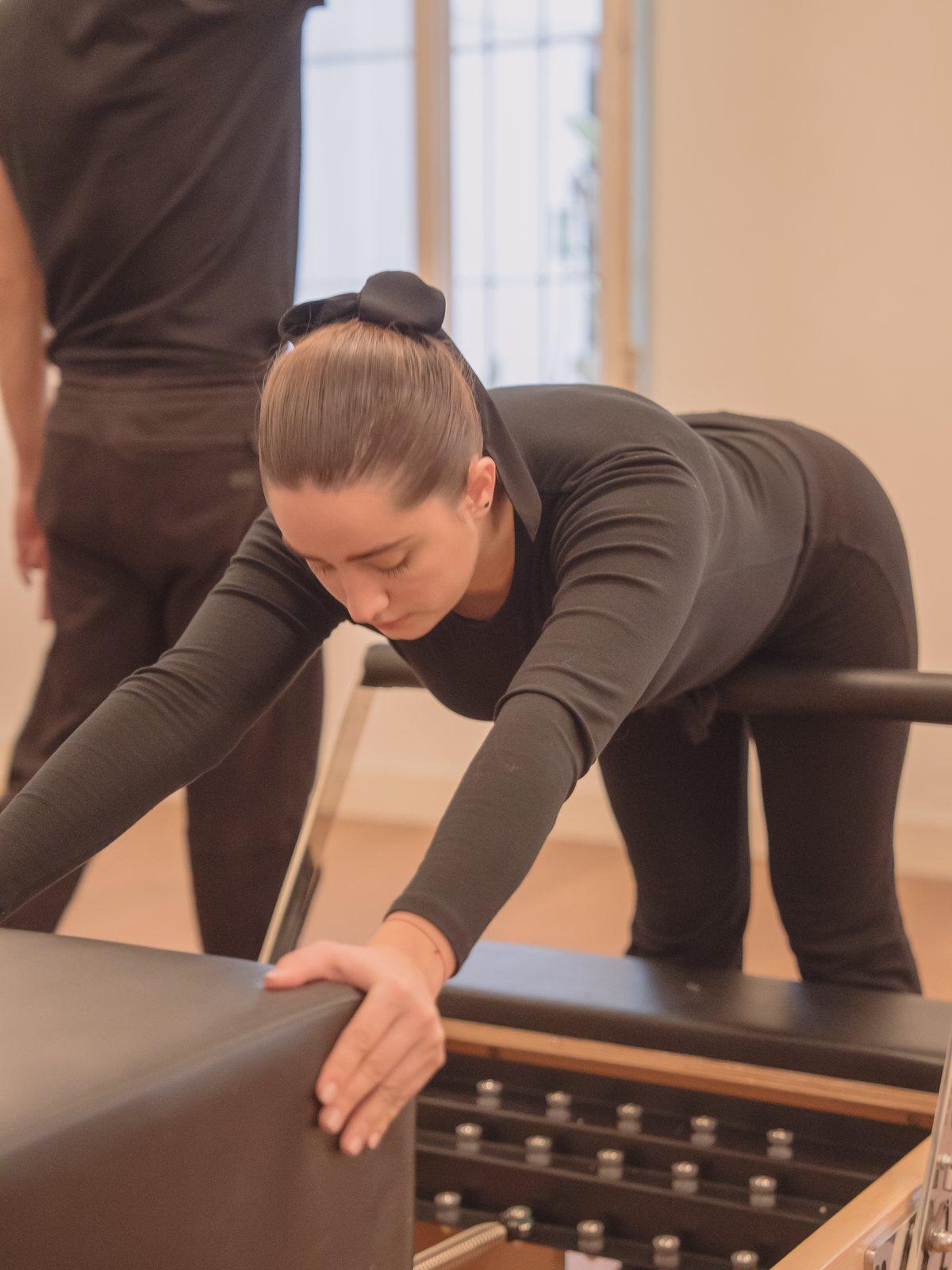
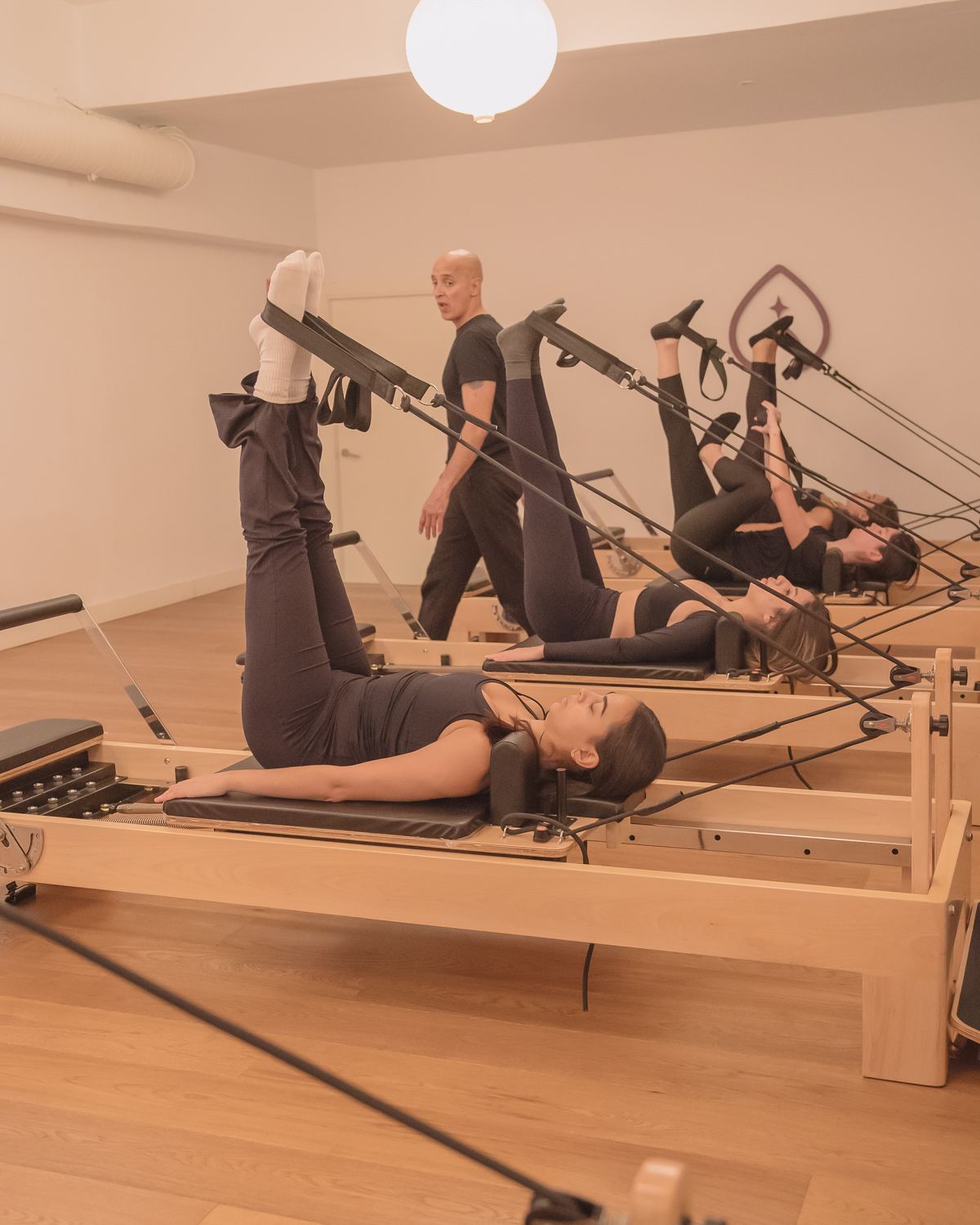
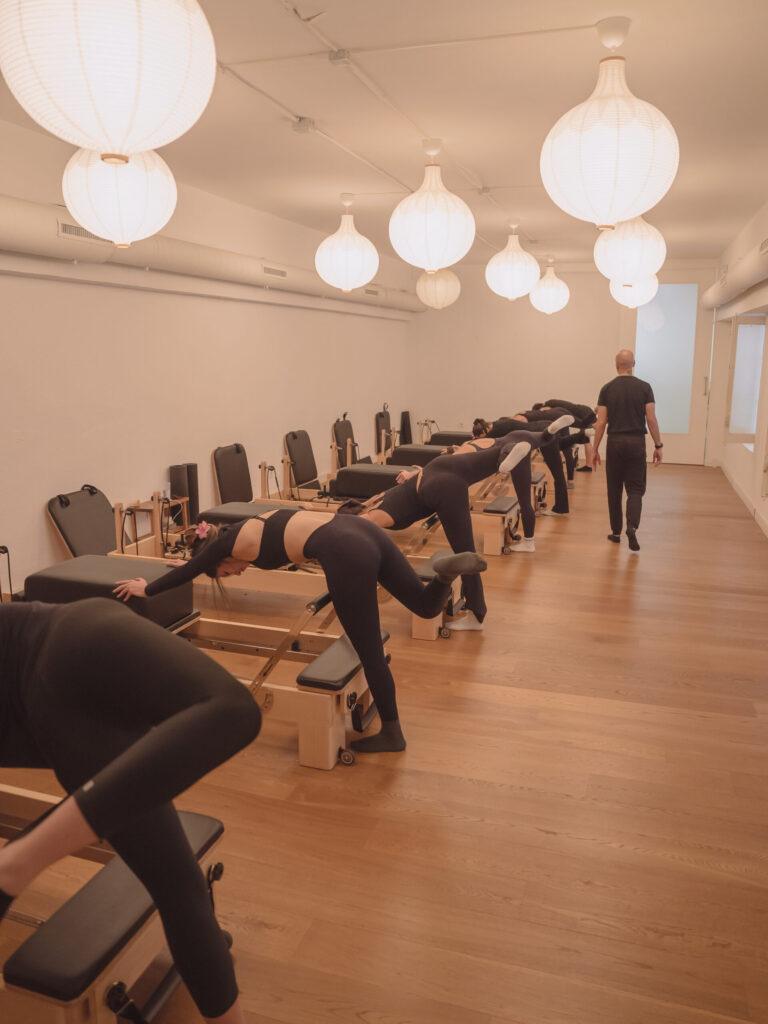
At Pinar Pilates, Reformer Pilates classes have a maximum of 8 students per session. This allows the instructor to observe and correct the position of your head and shoulders in every exercise. For neck pain, this supervision makes the difference between a therapeutic exercise and one that could make the problem worse.
More than 490 people have rated their experience at Pinar Pilates on Google, with an average of 4.9 out of 5.
Qualified Instructors
Our team is trained in functional anatomy and musculoskeletal conditions. When a student arrives with neck pain, we adapt the resistance of the springs, modify exercises that load the neck and prioritise decompression and stabilisation movements. If you have a medical diagnosis (cervical protrusion, cervical osteoarthritis, chronic neck pain), we ask you to share it so we can adjust the programme.
In the Heart of Salamanca
We are at Calle del Pinar 8, 28006 Madrid, five minutes’ walk from Gregorio Marañón metro station (lines 7 and 10) and less than a hundred metres from the Serrano-María de Molina bus stop. With more than 40 classes a week, finding a time compatible with your working day is easy. Many of our students come before or after work, precisely to counteract the effect of the hours in front of the computer.
Frequently Asked Questions
Is it safe to do Reformer Pilates with neck pain?
Yes, as long as you practise under qualified supervision and have ruled out serious conditions (cervical herniations with neurological involvement, cervical stenosis, fractures). The trial by De Araujo Cazotti et al. (2018) reported no adverse effects in the Pilates group. The Reformer allows you to work in unloaded positions where the neck does not bear the weight of the head, which makes it one of the safest options.
Can I do Pilates if I have a cervical disc protrusion?
In most cases yes, with the right adaptations. Loaded cervical flexion and sudden movements are avoided. Exercises in a neutral position and gentle extension are prioritised. Your doctor’s authorisation is essential and you must inform the instructor of your diagnosis.
How long until I notice relief from neck pain?
Many students report reduced muscle tension after the first 2 to 3 sessions. Sustained improvements in pain and function appear from 6 to 8 weeks of regular practice (2 to 3 sessions a week), according to the available evidence.
Is Reformer Pilates better than mat Pilates for neck pain?
The Reformer offers specific advantages: it allows fully unloaded work, the straps make gentle cervical traction possible, and the spring resistance can be adjusted to the millimetre. On the mat, many exercises involve holding up the head with the neck muscles, which can aggravate the pain. For neck pain, the Reformer is the most advisable option.
Want to relieve your neck pain with Reformer Pilates? Book your first class with 50% off and feel the difference.
If you are unsure whether Pilates is right for your case, call us on +34 611 994 729. We will guide you with no obligation.
You may also be interested in: Pilates for Back Pain in Madrid and Reformer Pilates for Pain: Complete Guide
Pinar Pilates · Salamanca district, Madrid
Your first reformer class, €15
Groups of 8 people maximum, specialist instructors and more than 40 classes a week. Your first class is half price.
Book my first classCalle del Pinar 8, Madrid · Questions? Message us on WhatsApp