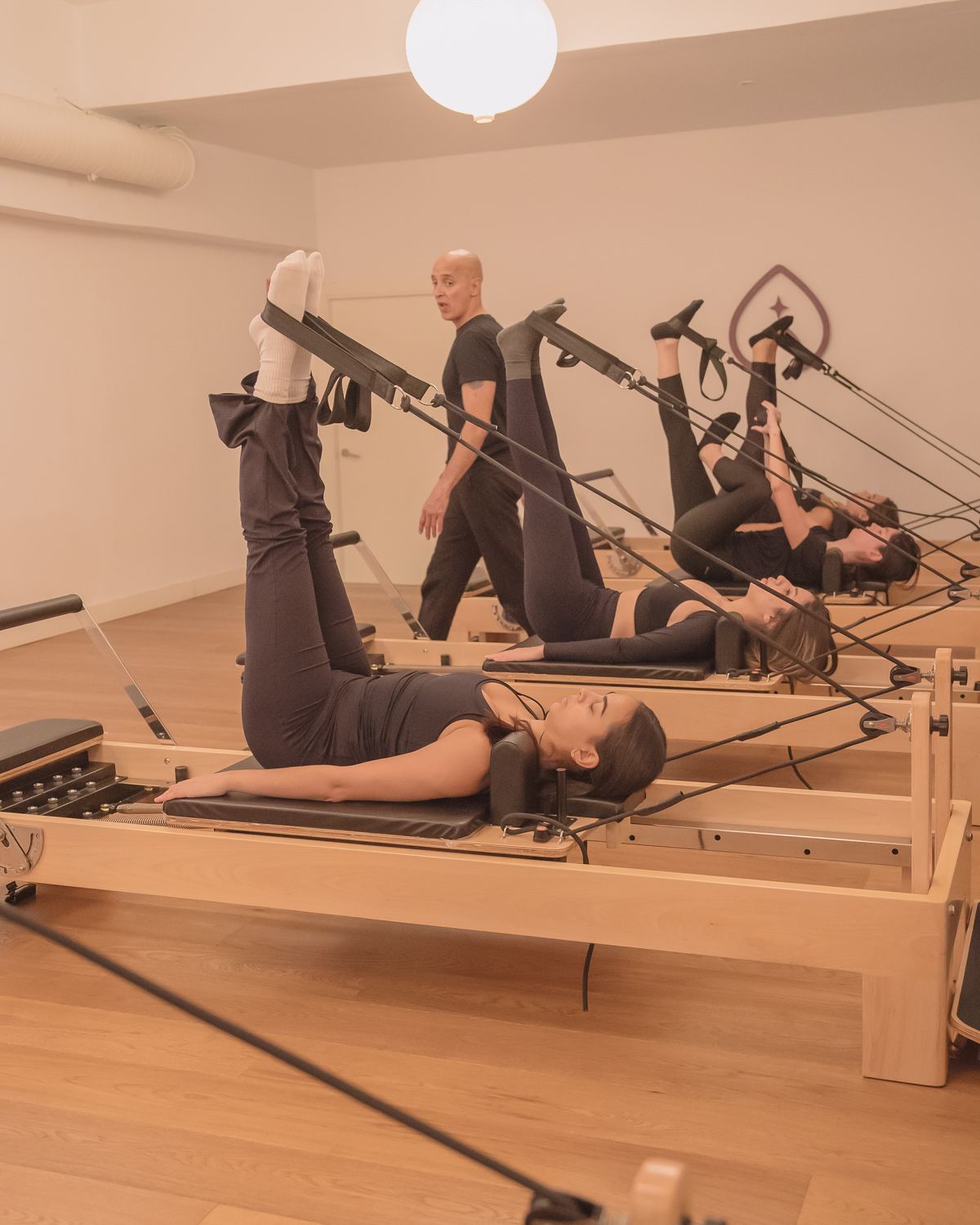
Both are Pilates. Both work the core, improve posture and strengthen the body. But the experience of practising Pilates on a mat and doing it on a Reformer are very different. The differences go beyond the presence or absence of a machine: they affect the variety of exercises available, safety for people with injuries, how quickly results show and the kind of supervision you receive.
If you are deciding between one and the other, or simply want to understand what each format offers, this comparison will help you choose with concrete information.
What Mat Pilates Is
Mat Pilates is the original format. Joseph Pilates developed his method (which he called “Contrology”) in the early 20th century using the body as the only tool. The 34 classic exercises in his book Return to Life Through Contrology (1945) are performed on a mat, with no additional equipment.
How it works
The student works lying down, seated or kneeling on a padded mat. The resistance comes exclusively from body weight and gravity. Some studios and classes add props such as resistance bands, small balls, Pilates rings (magic circle) or foam blocks, but they are not essential.
Typical exercises
The Hundred, Roll Up, Single Leg Stretch, Double Leg Stretch, Criss Cross, Swimming, Plank, Side Plank, Teaser. Most are floor exercises focused on abdominal control and stability.
Typical student profile
People looking for an accessible, affordable practice, who also want to train at home, or experienced practitioners who have mastered the technique and can work independently with their own body weight.
What Reformer Pilates Is
The Reformer is a machine designed by Joseph Pilates himself. It consists of a sliding carriage mounted on a frame with a system of springs that provide variable resistance, a footbar, straps with handles and shoulder blocks.
How it works
The student positions themselves on the carriage (lying, seated, kneeling or standing) and performs the exercises against the resistance of the springs. That resistance can be graded by changing the number and tension of the springs, which allows every exercise to be adapted to each person’s level and needs. The carriage slides, which adds an element of controlled instability that forces the body to stabilise constantly.
Typical exercises
Footwork, Pelvic Curl, Chest Lift, The Hundred on the Reformer, Long Stretch, Short Spine, Mermaid, Pulling Straps, Elephant, Knee Stretches, Semi-Circle, Snake. The Reformer repertoire exceeds 100 exercises with their variations.
Typical student profile
People looking for faster results, beginners who need the machine’s guidance to learn the movements correctly, people with back pain or injuries who need to work unloaded, and anyone who values the personal attention of small groups.
Head to Head: Reformer vs Mat
| Criterion | Mat Pilates | Reformer Pilates |
|---|---|---|
| Resistance | Body weight and gravity | Adjustable springs (from light to intense) |
| Exercise variety | 34 classic exercises + variations | More than 100 exercises + variations |
| Joint impact | Low, but bears full load | Very low, allows unloaded work |
| Adaptation to injuries | Limited (few modification options) | High (adjustable resistance and position) |
| Body feedback | Proprioceptive only | Machine + springs + proprioceptive |
| Core work | Intense (no external assistance) | Intense + spring-assisted |
| Average price per class | €10-15 (groups of 15-20 people) | €25-35 (groups of 6-10 people) |
| Usual group size | 15-25 students | 6-10 students |
| Equipment needed | Mat | Reformer machine |
| Practice at home | Yes, no equipment | Requires a machine (high cost) |
5 Advantages of Reformer Pilates over the Mat
1. More Exercise Variety and Positions
The Reformer lets you work lying on your back, on your front, on your side, seated, kneeling, standing on the carriage, standing beside the machine, and in multiple combinations with the straps and the bar. This translates into more than 100 possible exercises compared with the 34 of the classic mat repertoire.
That variety is not a whim: it lets you work every muscle group from different angles and adapt sessions so they do not become repetitive. After months of mat Pilates, many students feel the exercises no longer challenge them. On the Reformer, the repertoire is wide enough to keep progressing for years.
2. Immediate Feedback from the Machine
This is one of the points that makes the biggest difference in practice. When you push the Reformer carriage, the springs “respond”: if you lose control, the carriage moves erratically. If you stay stable, the movement is smooth. That constant feedback forces you to activate the right muscles and correct your posture intuitively.
A randomised controlled trial published in Complementary Therapies in Medicine (Cruz-Díaz et al., 2017) compared 12 weeks of equipment-based Pilates with mat Pilates in patients with chronic low back pain. Both groups improved in pain, function and transversus abdominis activation. But the equipment group showed faster improvements, and the researchers attributed this precisely to the proprioceptive feedback the equipment provides.
3. Safer for People with Injuries
The Reformer lets you work in unloaded positions (lying down, with the spine fully supported) and fine-tune the resistance by changing the springs. For someone with a herniated disc, sciatica or chronic low back pain, this is key.
In mat Pilates, if an exercise is too intense for you, the modification options are limited: you can bend your knees, reduce the range of movement or simply skip the exercise. On the Reformer, you can keep the same exercise but reduce the spring resistance, change the position of your feet on the bar, or use the straps to assist the movement. The capacity for adjustment is incomparably greater.
4. Faster Results
It is not only a subjective perception. The variable resistance of the springs lets you work with more intensity safely. On the mat, the only way to increase difficulty is to add repetitions or progress to more advanced exercises (which is not always possible or safe for everyone). On the Reformer, you can increase the spring load gradually, which produces faster muscular adaptations.
In addition, the instability of the sliding carriage forces the core to work reactively in every exercise, even the simplest ones. This means that a “basic” Reformer exercise can be a greater stabilisation stimulus than an advanced mat exercise.
5. Smaller Groups and Personal Attention
Mat Pilates classes usually have between 15 and 25 students. It is hard for an instructor to correct the posture of 20 people in a 50-minute class. Reformer classes, because of the space the machine takes up and the nature of the work, are limited to smaller groups.
At Pinar Pilates, for example, Reformer Pilates classes have a maximum of 8 people. That lets the instructor spend time on each student: correcting pelvic placement, adjusting the springs, checking that the movement starts from the right place. If you are starting out or have an injury, that supervision is the difference between an exercise that helps and one that harms.
When to Choose Mat Pilates
Mat Pilates has its place. It is not worse than the Reformer, it is different, and there are situations in which it may be the better choice.
A tight budget
If keeping costs low is your priority, mat Pilates is more affordable. Group classes cost between €10 and €15, and you can complement them with practice at home without any equipment.
Independent practice at home
If you travel a lot or prefer to train at home, the mat is the practical option. You only need a mat and a clear space. There are online platforms with complete mat Pilates programmes you can follow on your own.
Experienced practitioners
If you have been practising Pilates for years, have excellent body control and know the technique well, mat Pilates can be enough of a challenge. Working with body weight alone, without the assistance of the springs, demands a very high capacity for stabilisation. For an advanced practitioner, a Teaser on the mat is harder than on the Reformer.
When to Choose Reformer Pilates
If you are a beginner
It may seem contradictory, but the Reformer is easier to start with than the mat. The springs assist the movements, the machine guides the path and the instructor can adjust the resistance to your level. On the mat, a beginner depends entirely on their own strength and coordination, which can be frustrating and increase the risk of compensations.
If you have never done Pilates, you can book your first class at 50% off at Pinar Pilates to discover the Reformer at half price.
If you have back pain or an injury
As we have explained, the Reformer lets you work unloaded, grade the resistance and modify every exercise. For back, knee, hip or shoulder problems, the Reformer offers a safer, more adaptable environment.
If you want fast results
The variable resistance, the greater variety of exercises and the machine’s feedback mean that results (strength, muscle tone, better posture) show sooner. If your time is limited and you want to get the most out of every session, the Reformer is more efficient.
If you value personal attention
Groups of 8 people versus groups of 20. Individual instructions versus generic cues for the whole room. If you want someone to watch your technique and adapt the exercises to your body, the Reformer format allows it.
Our Recommendation
If you can choose, start with the Reformer. Not because the mat is bad, but because the Reformer gives you three things that are especially valuable at the beginning: mechanical guidance for learning the movements, resistance adaptable to your level and close supervision in small groups.
Once you have mastered the fundamentals on the Reformer, you can add mat sessions as a complement. Many of our students at Pinar Pilates combine both formats, and those who started on the Reformer say it was easier to understand the mat exercises afterwards than the other way round.
At Pinar Pilates, in the heart of the Salamanca district (Calle del Pinar 8, Madrid), we offer Reformer Pilates classes in groups of 8 people maximum. Our prices go from €100/month for 4 classes to €250/month with unlimited access. A drop-in class costs €30.
Want to try it? Book your first class at 50% off and see the difference for yourself.
More than 490 people have rated their experience at Pinar Pilates on Google, with an average of 4.9 out of 5.
Frequently Asked Questions
Is Reformer Pilates harder than mat Pilates?
Not necessarily. The Reformer has exercises at every level, from very basic to very advanced. For a beginner, certain exercises are easier on the Reformer than on the mat because the springs assist the movement. However, advanced Reformer exercises (such as Long Stretch or Snake) can be very demanding. The level depends on the programming, not on the machine itself.
Can I do Reformer if I have never done Pilates?
Yes, and in fact it is a good way to start. The machine guides you, the instructor adjusts the resistance to your level and the small groups allow supervision that makes learning easier. At Pinar Pilates you can book your first class at 50% off to try the Reformer at half price.
Why is Reformer Pilates more expensive than mat Pilates?
For three concrete reasons. First, the equipment: a professional Reformer costs between €3,000 and €6,000. Second, the space: each machine takes up around 4 square metres, which limits capacity. Third, the instructor-to-student ratio: with groups of 6 to 10 people (versus 15-25 on the mat), the cost per student is higher. The price reflects a service with more individual attention, not an arbitrary mark-up.
More questions about which format suits you? Call us on +34 611 994 729 or drop by our studio in the Salamanca district. We will be happy to advise you.
Pinar Pilates · Salamanca district, Madrid
Your first reformer class, €15
Groups of 8 people maximum, specialist instructors and more than 40 classes a week. Your first class is half price.
Book my first classCalle del Pinar 8, Madrid · Questions? Message us on WhatsApp