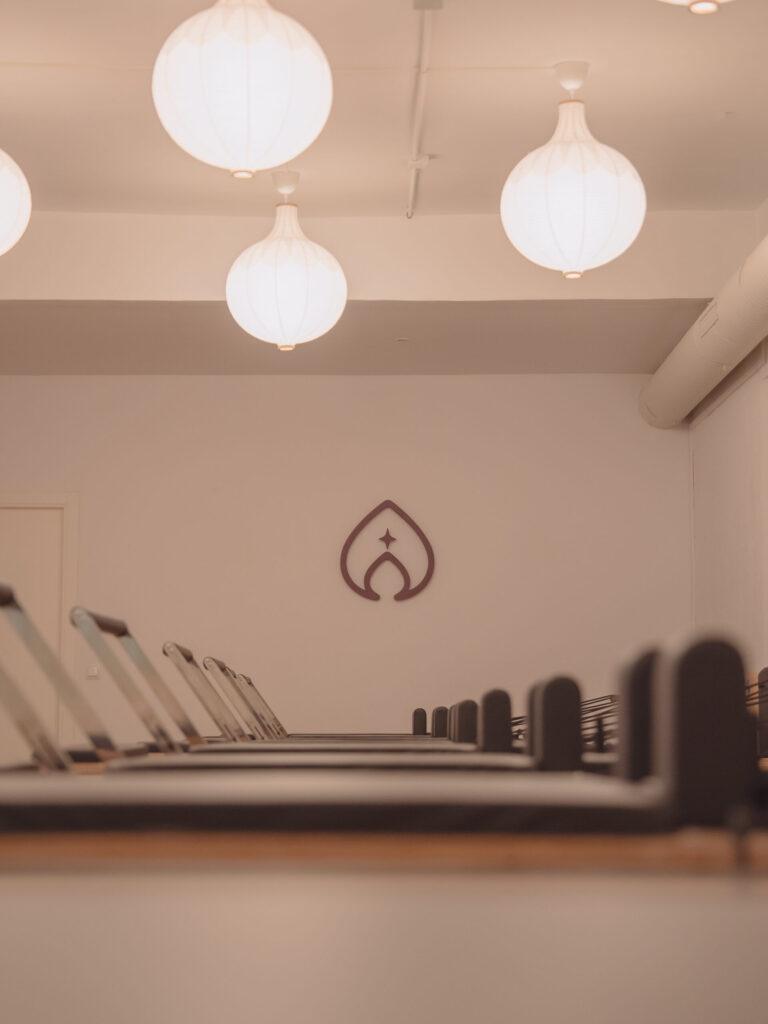
You have seen the machine on Instagram, in a studio as you walked past, or at your physiotherapist’s. It has a look that sparks immediate curiosity: a sliding carriage, straps, springs, a bar. It looks like no conventional gym equipment. And if you have wondered exactly what Reformer Pilates is, how it works and whether it is for you, this guide answers every one of those questions.
Reformer Pilates is a form of the Pilates method practised on a specific machine called the Reformer. It combines variable resistance, control of movement and postural work in a system that adapts to complete beginners and elite athletes alike. But to understand what it is about, it is worth starting at the beginning.
History of Reformer Pilates
The Reformer was born out of necessity. Joseph Hubertus Pilates (1883-1967), born in Germany, developed his training method during the First World War. Interned in a prison camp on the Isle of Man (United Kingdom), Pilates began using the springs from hospital beds to create a system of exercises that allowed wounded soldiers to rehabilitate without getting up.
That improvised contraption of bed springs was the first prototype of what we know today as the Reformer. When Pilates emigrated to New York in 1926 and opened his studio with his wife Clara, he perfected the design: a wooden frame with a sliding carriage, a system of springs of different tension, a bar for the feet and straps with handles.
The name “Reformer” reflects its creator’s intention: to reform the body, to return it to its natural functional state. Joseph Pilates called his method “Contrology”, the science of conscious control of movement.
From the 1940s to today, the design of the Reformer has evolved in materials (from the wooden frame to aluminium and steel), but the mechanical principles remain practically intact. The modern Reformers you will find in studios such as Pinar Pilates are more precise and versatile, but they still work with the same spring-and-carriage system Joseph Pilates conceived almost a century ago.
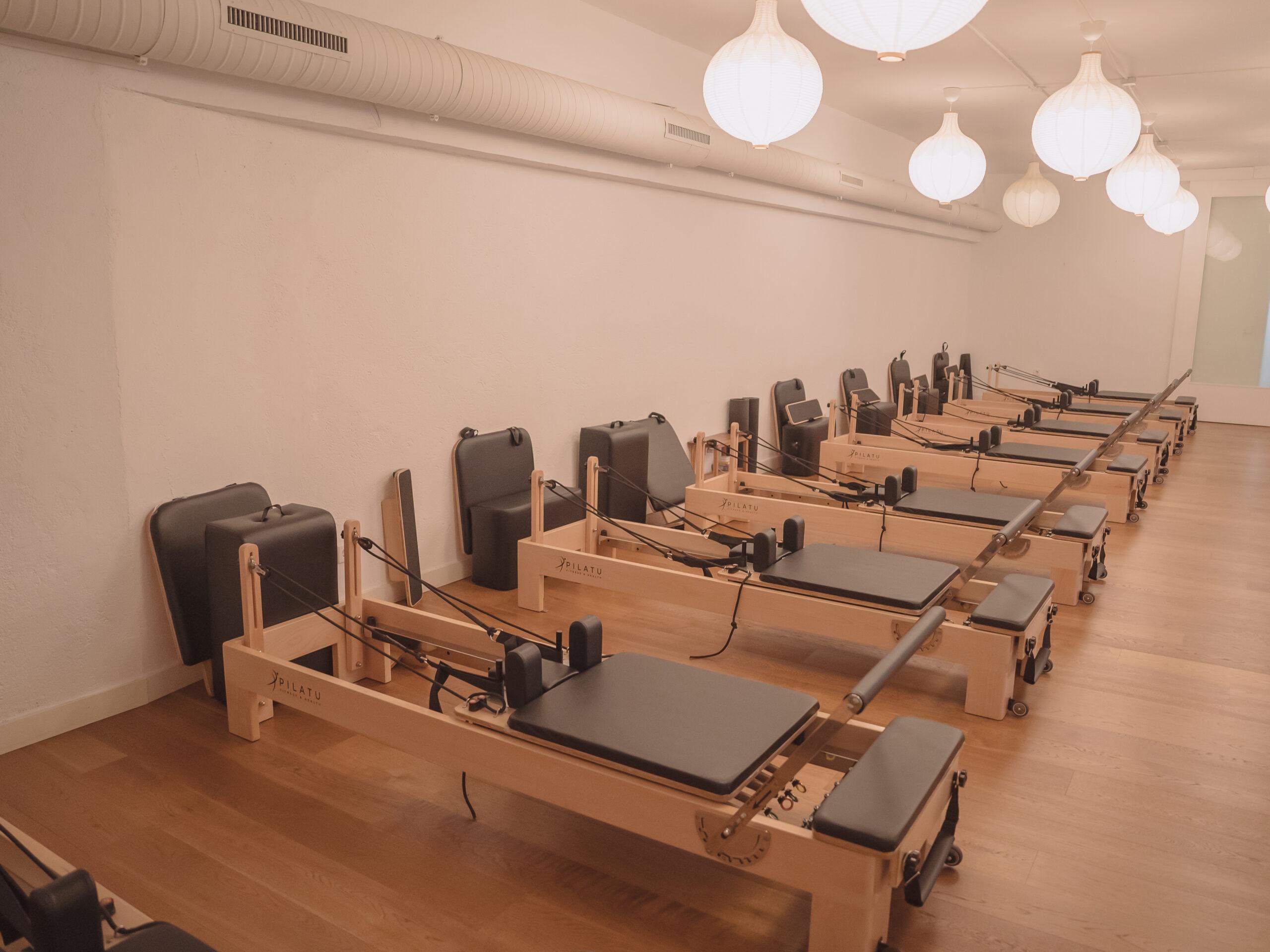
Anatomy of a Reformer Machine
Understanding the parts of the Reformer will help you feel more prepared for your first class. Each element has a specific function.
The Carriage
This is the central padded platform that slides along the rails of the frame. It is where you position yourself for most exercises: lying on your back, face down, on your side, seated, kneeling or standing. The carriage moves when you push or pull against the resistance of the springs.
The Springs
These are the Reformer’s resistance system. They hook between the carriage and the frame. Each spring has a specific tension, usually identified by a colour code. As you push the carriage out, the springs provide resistance. As you return, they provide assistance. By combining springs of different tension, the difficulty of each exercise can be graded very precisely.
A key point: spring resistance is not linear. The further you push the carriage, the greater the resistance. This creates a progressive loading pattern that respects the natural mechanics of the body.
The Footbar
A height-adjustable horizontal bar at one end of the Reformer. It is used to push with the feet (in squat-type exercises) or with the hands (in pushing exercises). The different heights allow the position to be adapted to the type of exercise and to each person’s anatomy.
The Straps
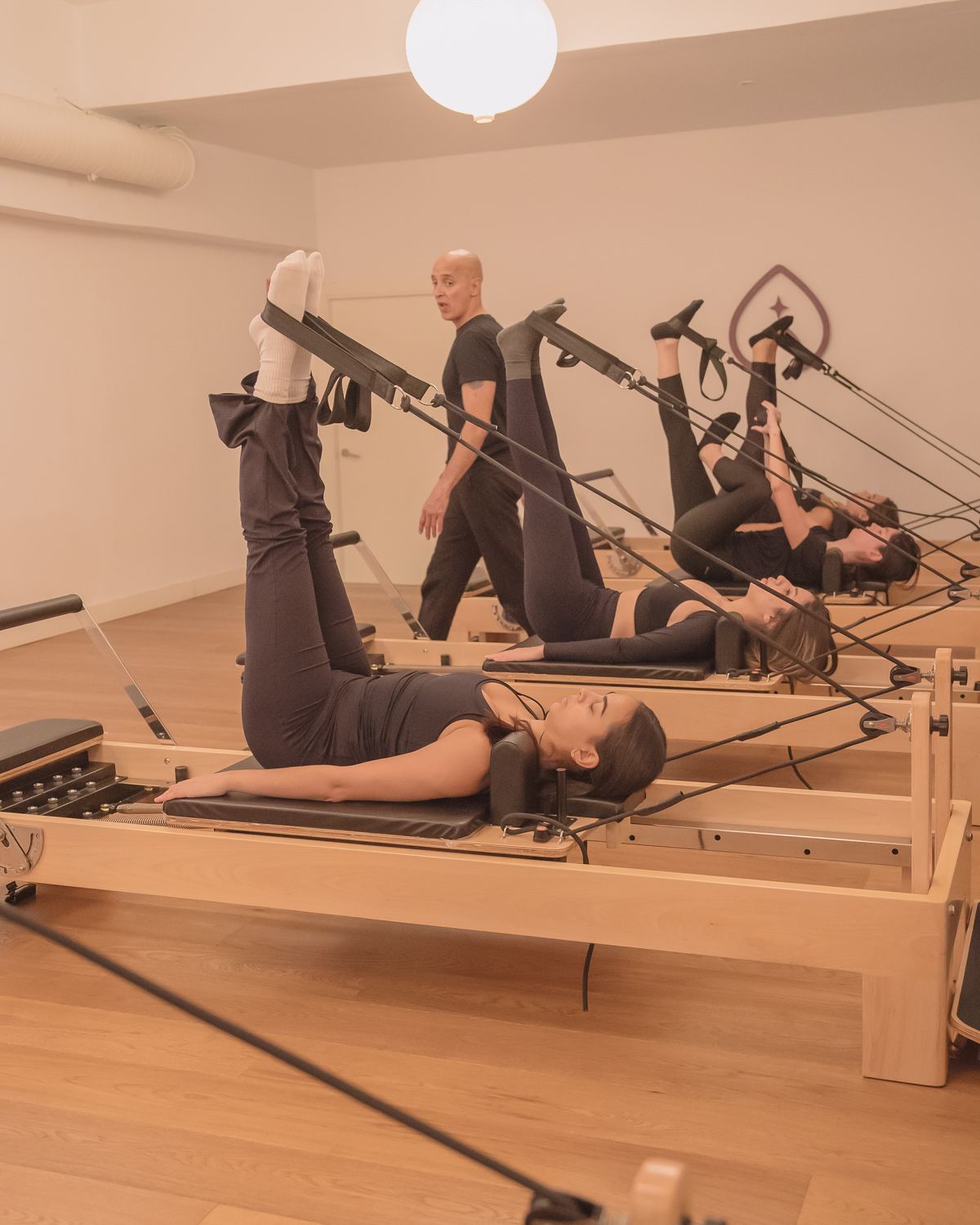
Two ropes that run through pulleys at the opposite end to the footbar. They end in handles or loops that go on the hands or feet. They allow pulling, extension, abduction and rotation exercises of the limbs against the resistance of the springs.
The Headrest
A padded support for the head with adjustable positions (flat, intermediate and raised). It is changed according to the exercise to keep the cervical spine in a neutral position. For example, it is raised during abdominal exercises to avoid neck tension, and lowered during exercises where the spine needs full extension.
How a Reformer Pilates Class Works
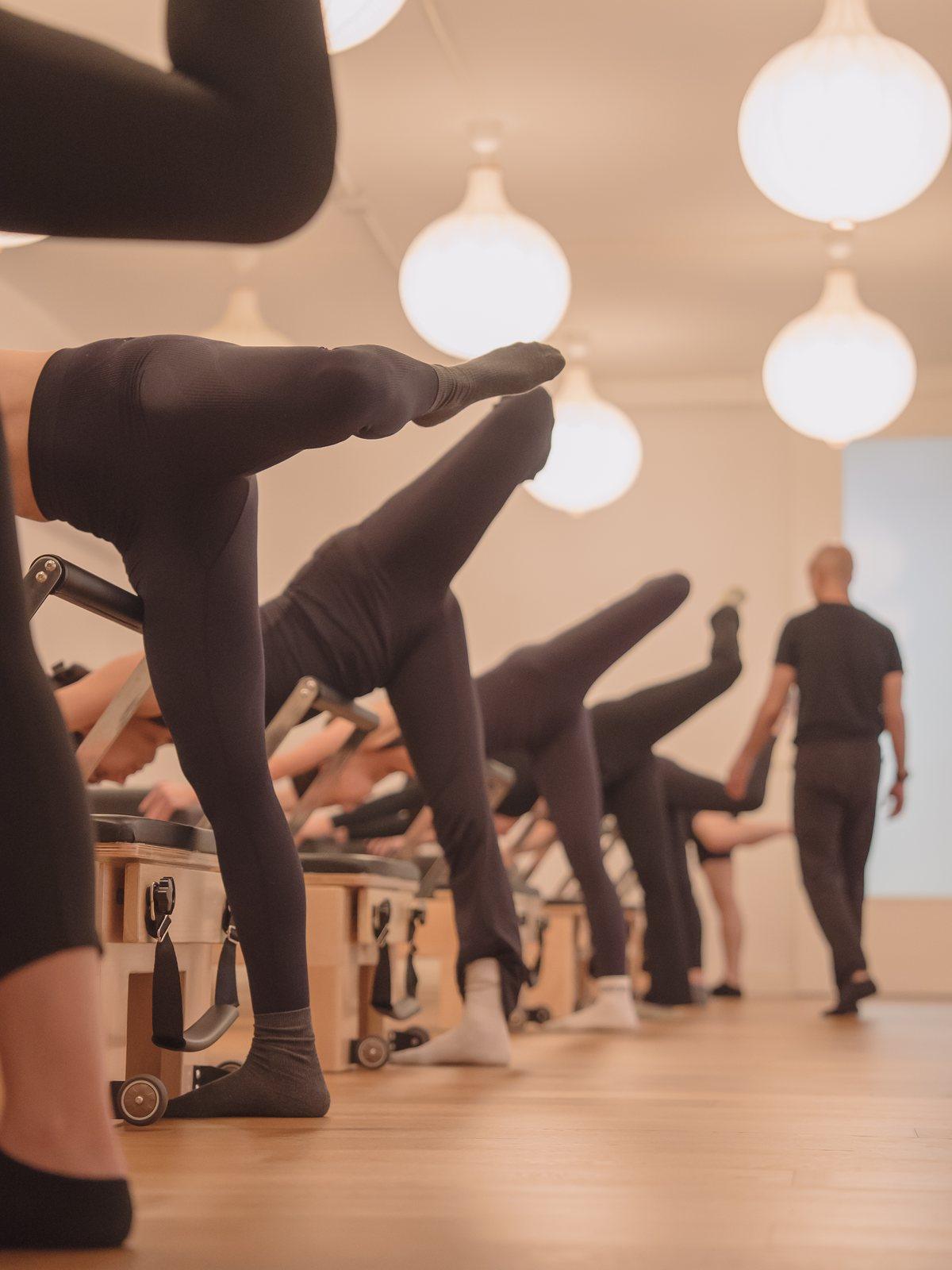
A typical Reformer Pilates class lasts between 50 and 55 minutes. At Pinar Pilates, sessions follow a structure designed to work the whole body progressively.
Warm-up (5-8 minutes). The class begins with gentle mobilisation exercises and core activation. Footwork (feet on the bar) is one of the most common openers: it gets you used to the movement of the carriage and prepares the leg muscles.
Main block (30-35 minutes). Sequences of exercises that work different muscle chains. The instructor alternates between leg, abdominal, arm, back and hip exercises. Positions keep changing: on your back, on your side, seated, kneeling. Spring resistance is adjusted according to the exercise and each person’s level.
Final work and cool-down (10-12 minutes). Active stretching exercises, spinal mobility and work on the smaller muscles (shoulder stabilisers, abductors). The session ends with a lengthening sequence that leaves a feeling of openness and relief.
As for the format, small groups make an enormous difference. At Pinar Pilates, each class has a maximum of 8 people. This allows the instructor to watch each student’s execution, correct alignment and adapt exercises when necessary. We offer more than 40 classes a week with different levels, from beginner to advanced.
Differences between Reformer Pilates and Mat Pilates
Both are Pilates and share the same principles: control, concentration, centre, flow, precision and breathing. But the practical experience is very different.
On the mat, the resistance is your own body weight. On the Reformer, the resistance is variable and adjustable through the springs. This has two direct implications: beginners can receive assistance from the machine to perform movements that would be too hard on the floor, and advanced practitioners can add extra load that body weight alone does not provide.
The Reformer also provides immediate feedback. If you lose alignment or control, the carriage moves unevenly or hits the stops. That forces you to maintain concentration and stability at all times.
The Reformer repertoire is wider: more than 100 exercises with variations, compared with the 34 classic mat exercises. And the versatility of positions (lying, seated, standing, kneeling, on the side) lets you work the body from angles the floor does not allow.
If you want a detailed comparison covering every criterion (price, effectiveness, joint impact, adaptation to injuries), we recommend our full article on Reformer Pilates vs mat Pilates
Who Reformer Pilates Is For
One of the great advantages of the Reformer is its versatility. The machine adapts to the user, not the other way round. These are the profiles that benefit most.
Beginners with no sporting background. The springs assist the movements and the instructor adapts every exercise. You do not need prior strength, flexibility or coordination. If you want to go deeper into how to start, read our guide to equipment Pilates for beginners
People with back pain or injuries. The Reformer lets you work unloaded, without bearing your body weight on the affected area. It is one of the reasons physiotherapists and orthopaedic specialists recommend Reformer Pilates as a complement to rehabilitation. More information in our article on Reformer Pilates and back pain
Older people. The spring system allows the intensity to be adjusted down to very gentle levels, and the work is done in safe positions (lying or seated). Improved balance, functional strength and bone density make the Reformer an ideal tool for maintaining independence and quality of life with age.
Athletes looking to complement their training. Runners, tennis players, cyclists and swimmers use the Reformer to work on core stability, correct muscle imbalances and improve joint mobility.
People who sit for many hours at work. The combination of postural strengthening, thoracic opening and spinal mobilisation makes the Reformer an antidote to the consequences of sedentary work.
Pregnant and postnatal women. With the right adaptations and the supervision of a trained instructor, the Reformer can be practised during pregnancy and is an excellent tool for postnatal recovery.
Main Benefits of Reformer Pilates
The benefits of Reformer Pilates are backed by scientific research published in leading medical journals. The most relevant include:
- Reduction of chronic back pain. A review by Wells et al. (2014) in PLOS ONE confirms it.
- Deep core strengthening. The Reformer activates the transversus abdominis, the multifidus and the pelvic floor more effectively than many conventional exercises.
- Improved posture. Systematic work on the spinal extensors and scapular stabilisers corrects postural imbalances.
- Increased flexibility, safely. The springs support active stretching, reducing the risk of injury.
- Better balance and coordination. Especially relevant for older people.
- Mental health benefits. The concentration required during practice reduces stress and improves emotional wellbeing.
For an in-depth review with the scientific studies behind each benefit, see our article on the 10 benefits of Reformer Pilates
Where to Practise Reformer Pilates in Madrid
The range of Reformer Pilates in Madrid has grown a great deal in recent years. From big chains to boutique studios, the options are varied. What matters is choosing a place that prioritises the quality of instruction and personalised attention.
At Pinar Pilates, our boutique studio in the Salamanca district (Calle del Pinar 8, 28006 Madrid), we believe these are the elements that make the difference:
Groups of a maximum of 8 people. This is the format that allows real correction. With 8 students and one instructor, each person receives direct attention in every exercise.
More than 40 classes a week. We offer morning, midday and evening times so you can find the moment that works with your routine. See the full class calendar
A team of specialised instructors. Giuliana Di Giovanni, Gabriela Seminara, Camila T, Montserrat Sierra and Abel Gomez. Specific training in Reformer Pilates and experience with every profile: beginners, people with injuries, pregnant women, athletes.
4.9 out of 5 on Google with more than 490 reviews. Our students’ experience is our best introduction.
Accessible prices. From €100/month with the 4-class plan to €250/month with the unlimited plan. Single class €30. And to get started, your first class at 50% off for only €15. All the details on our prices page
If you are just starting, your first class at 50% off for only €15 is the perfect way in. If you want to know more about the studio and its philosophy, visit our main page on Reformer Pilates in Madrid
Frequently Asked Questions
What exactly is Reformer Pilates?
Reformer Pilates is a form of the Pilates method practised on a machine called the Reformer, designed by Joseph Pilates in the early 20th century. The machine uses a system of springs, a sliding carriage, straps and a footbar to create variable resistance. This allows each exercise to be adapted to each person’s level and the whole body to be worked with control, precision and safety.
Is Reformer Pilates suitable for people with no experience?
Yes. In fact, the Reformer was originally conceived as a rehabilitation tool for people with physical limitations. The springs can assist the movements, making them accessible to someone who has never exercised. The key is to go to a studio with small groups and qualified instructors who can guide you from day one.
What is the difference between Reformer Pilates and mat Pilates?
Mat Pilates uses body weight as the only resistance, while the Reformer adds a spring system that allows each movement to be assisted or intensified. The Reformer offers more than 100 exercises (compared with 34 on the mat), allows joint-unloaded work and provides immediate feedback on the quality of movement.
How many times a week is Reformer Pilates recommended?
To notice significant results, the ideal is to practise 2 to 3 times a week. At this frequency, most people begin to notice improvements in posture, strength and flexibility within the first 4-6 weeks. Our 8-class monthly plan is designed for this recommended frequency.
Try Reformer Pilates
Now that you know what Reformer Pilates is, how it works and who it is for, the next step is to experience it. No guide can replace the feeling of moving on the machine, feeling the resistance of the springs and discovering muscles you did not know you had.
At Pinar Pilates we make it easy:
- First class at 50% off for only €15: your first contact with the Reformer, explained step by step.
We are at Calle del Pinar 8, Salamanca district, Madrid. Call us on +34 611 994 729 if you have any questions. We have spent years helping people discover what the Reformer can do for their bodies. We would love to help you too.
Pinar Pilates · Salamanca district, Madrid
Your first reformer class, €15
Groups of 8 people maximum, specialist instructors and more than 40 classes a week. Your first class is half price.
Book my first classCalle del Pinar 8, Madrid · Questions? Message us on WhatsApp