It is 19:00. You have been sitting for nine hours. Your shoulders feel heavy, your lower back complains every time you stand up and your neck has turned into a block of concrete. You leave the office and you have two options: go home and carry on sitting on the sofa, or invest 50 minutes in reversing everything the chair has done to you during the day.
This is the second option. A Reformer Pilates session designed specifically to undo the damage of sedentary work. It is not a generic class. Every exercise you are about to read has a specific purpose: to open what the office closes, activate what the chair switches off and release the tension you accumulate without realising.
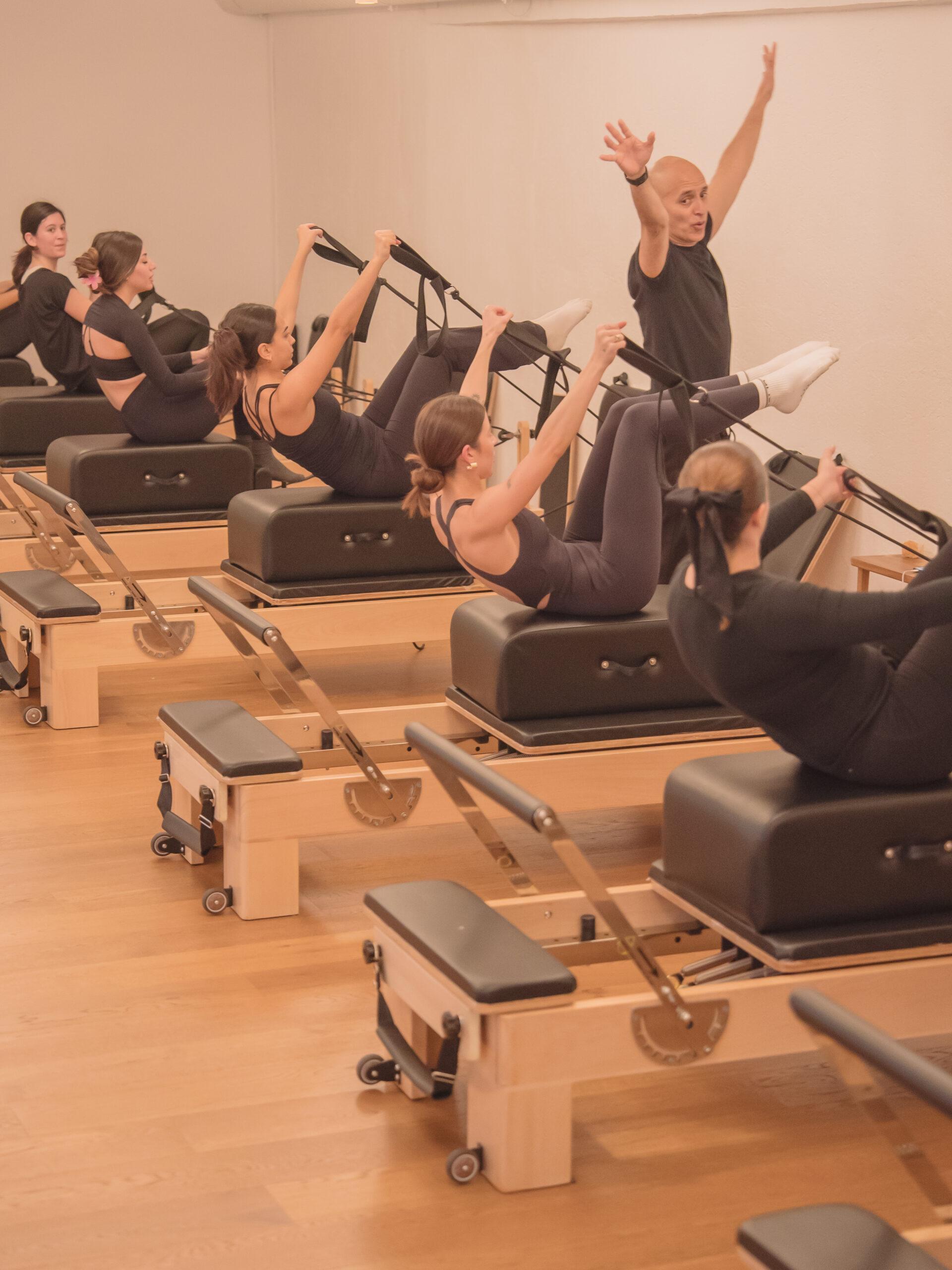
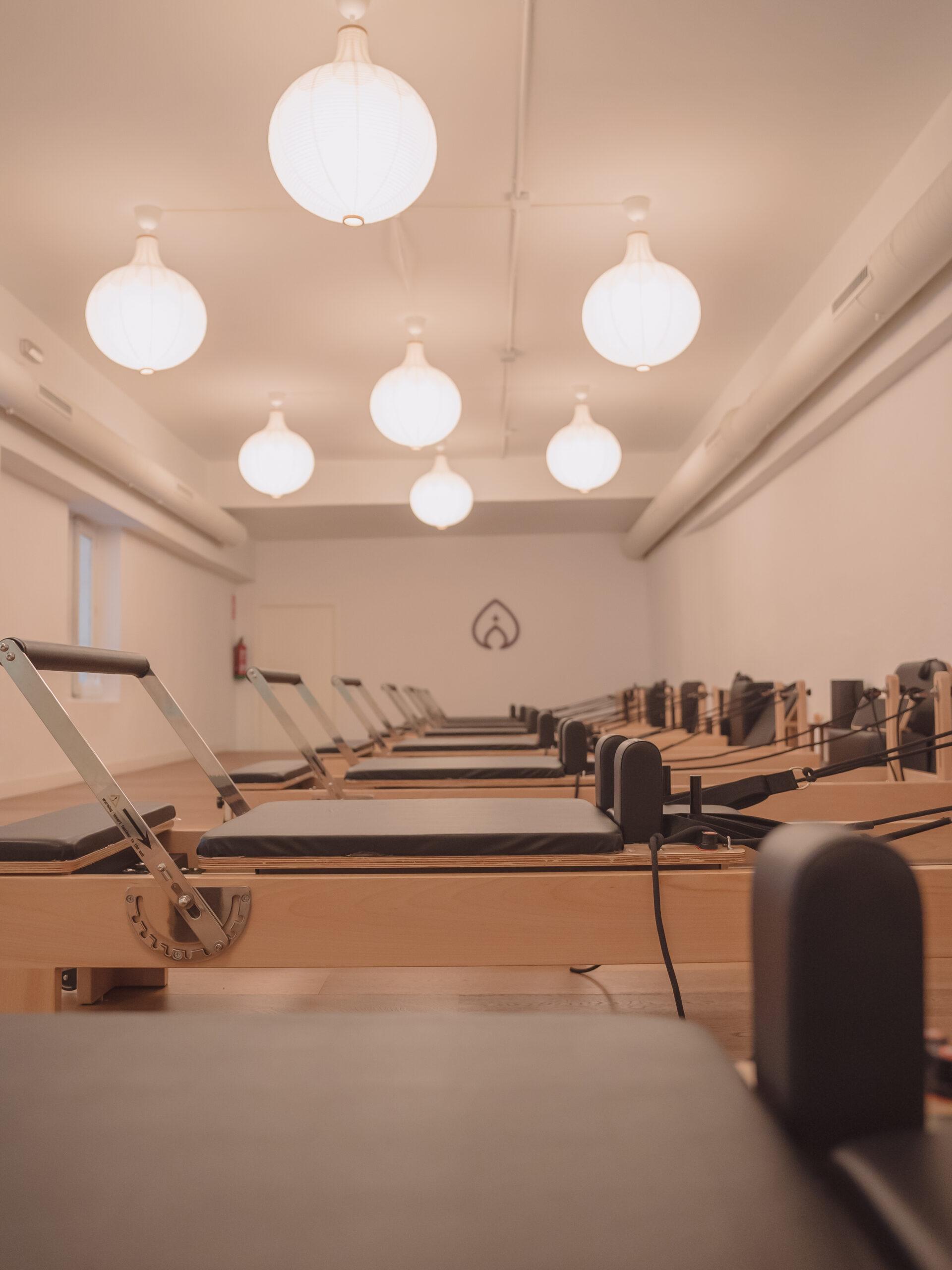
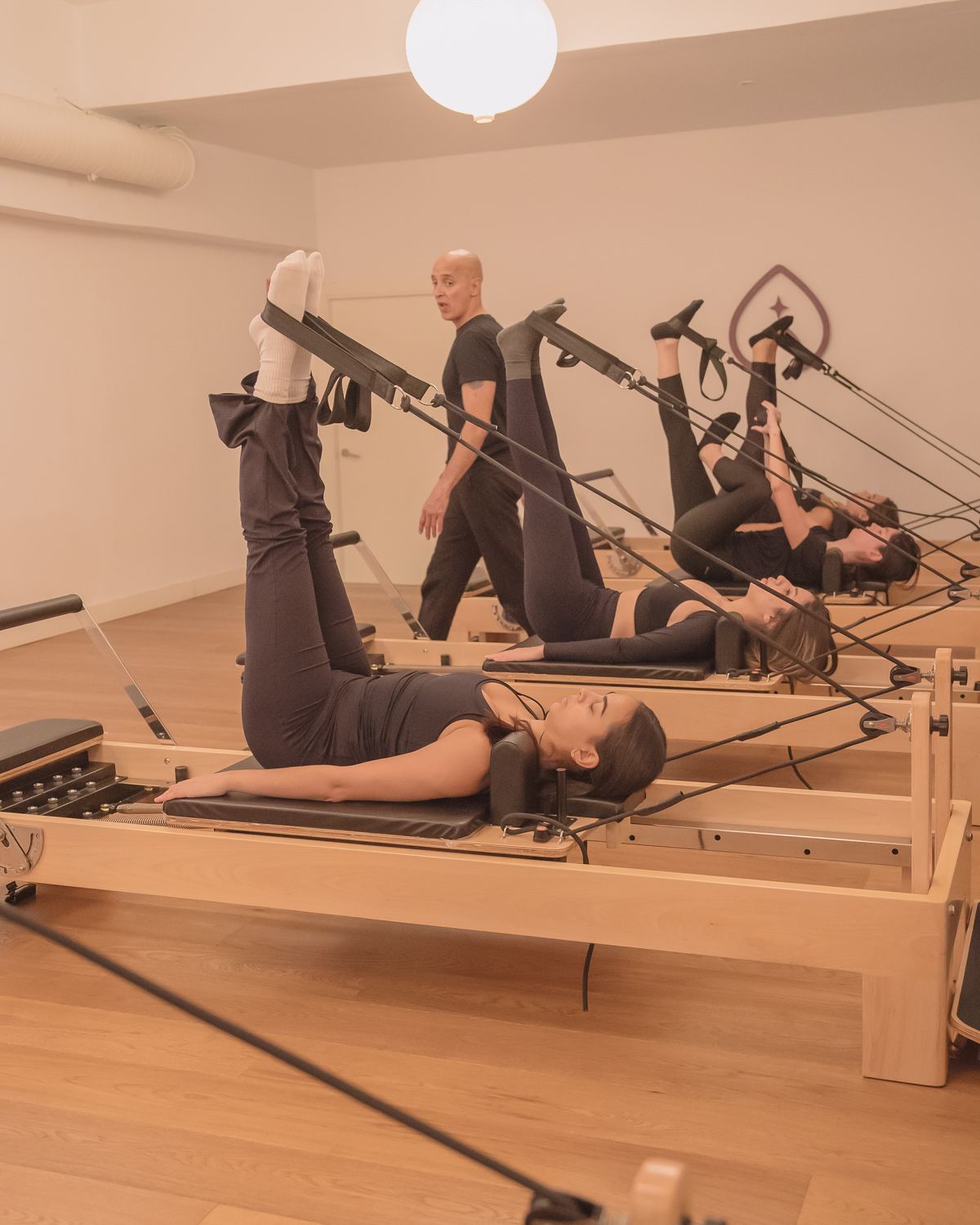
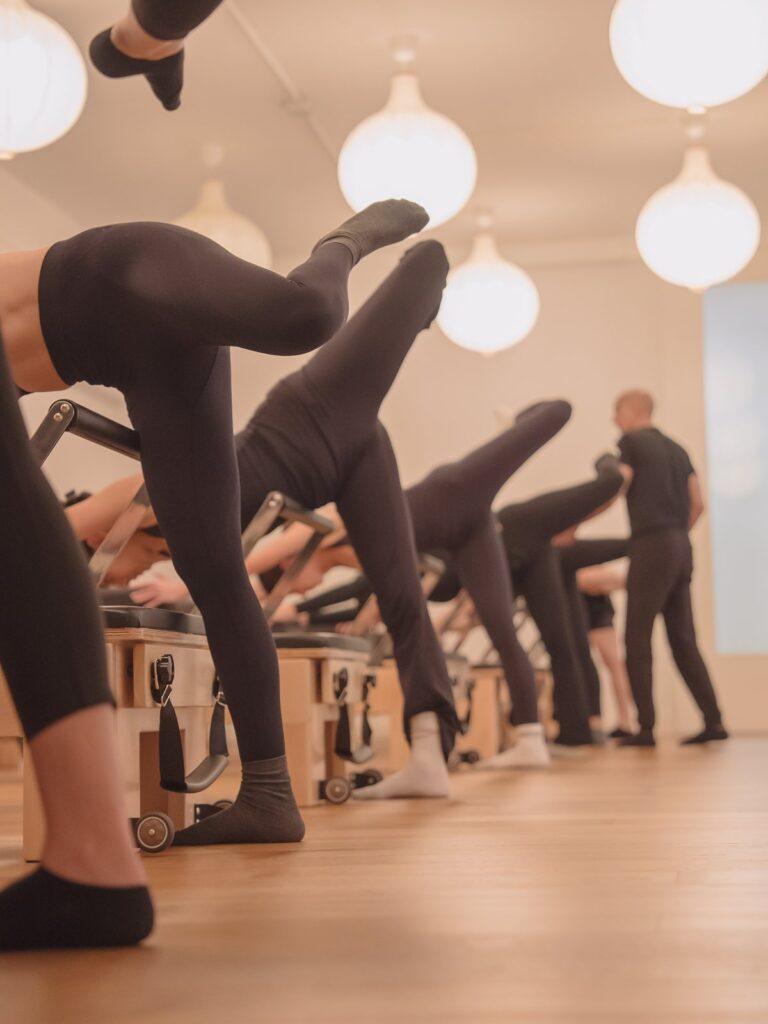
At Pinar Pilates, in the Salamanca district (Calle del Pinar 8, 28006 Madrid), this is one of the sessions our professional students repeat most. Groups of a maximum of 8 people, constant correction from the instructor and 50 minutes that completely change how you feel when you get home.
Here is the full routine broken down into three blocks: warm-up, main block and cool-down.
What 8 Hours of Sitting Do to Your Body
Before getting into the exercises, it helps to understand what we are correcting. When you spend the whole working day in a chair, a predictable pattern of deterioration takes place:
Shortened hip flexors. The psoas and the rectus femoris stay in a shortened position for hours. They tighten, pull the pelvis forward and create a lumbar hyperlordosis that causes pain in the lower back.
Switched-off glutes. The gluteus maximus stops working as a stabiliser of the pelvis. This phenomenon, known as gluteal amnesia, forces the lower back and the hamstrings to compensate and become overloaded.
Stiff thoracic spine. The hunched position in front of the computer blocks the mobility of the mid-back. The extensors of the middle back weaken, the pectorals shorten and the shoulders round forward.
Neck tension. The upper trapezius, the scalenes and the suboccipital muscles tighten because of the forward head position in front of the screen. The result: stiffness, neck pain and tension headaches.
This routine tackles each of these problems systematically. If you want to go deeper into how the Reformer corrects your posture, see our guide on posture and Reformer Pilates.
Block 1: Warm-Up (10 minutes)
The aim of the first 10 minutes is to raise body temperature, connect with the breath and start mobilising the most blocked areas. It is not about stretching cold or forcing. It is about waking the body up progressively.
Breathing (Lateral costal breathing lying on your back, 3 minutes)
Lying on your back on the carriage, feet on the bar, knees bent. This is the moment of transition between the office and the class.
Breathe in through the nose for 4 counts, expanding the ribs sideways (not upwards). Breathe out through the mouth for 6 counts, feeling the ribs close and the transversus abdominis engage. Repeat 8 full cycles.
What you achieve: activating the diaphragm (which has been compressed all day by the seated posture), lowering the activation level of the sympathetic nervous system and connecting with the deep core muscles. The prolonged exhalation stimulates the vagus nerve, starting the calm response of the parasympathetic nervous system.
Pelvic Clock (3 minutes)
Same position. Imagine a clock face on your pelvis: 12 at the pubic bone, 6 at the sacrum, 3 and 9 at the hip bones. Move the pelvis slowly through all the hours of the clock, in both directions.
What you achieve: mobilising the lumbar area and the sacroiliac joint, which have been locked for hours. Starting to identify asymmetries and areas of stiffness. Breathe out when the pelvis tilts towards 12 (posterior tilt), breathe in when it goes towards 6 (anterior tilt).
Basic Footwork (short series, 4 minutes)
Feet on the bar in three positions: parallel (toes and heels), Pilates V and hip-width apart. 8 repetitions in each position, with 2 medium springs and 1 heavy.
Breathe out as you push the carriage, breathe in as you return. Keep the pelvis neutral, the shoulders away from the ears and the core connected.
What you achieve: activating the leg muscles (quadriceps, hamstrings, calves, glutes) in a controlled way. Warming up the ankle, knee and hip joints. Establishing the core-to-limb connection you will need in the main block.
Block 2: Main Work (30 minutes)
This is where the real work begins. Each exercise is chosen to counteract a specific effect of sedentary life. The sequence follows a logic: first we open the hips, then we work the thoracic spine, then we strengthen the posterior chain and we finish with the upper body.
Hip Flexor Stretch on the Reformer (4 minutes)
One knee on the carriage, the other foot on the platform. The carriage moves back while the hip on the side of the kneeling leg opens into extension. 2 light springs.
Breathe out as you push the carriage back and feel the stretch at the front of the hip. Breathe in as you return. 8 repetitions per side, holding the last one for 10 seconds.
What you achieve: lengthening the hip flexors (iliopsoas and rectus femoris) that have been in a shortened position all day. This is probably the most important exercise of the whole routine for someone who works sitting down. Releasing the psoas reduces the pull on the lumbar spine and relieves lower back pain.
Bridging with Variations (4 minutes)
Lying on your back, feet on the bar. Peel the pelvis off the carriage vertebra by vertebra until you form a straight line from the shoulders to the knees. 2 medium springs.
Set 1: 8 repetitions of the classic articulated bridge. Breathe out as you lift, breathe in at the top, breathe out as you lower.
Set 2: Held bridge with alternating single-leg extension. 6 repetitions per side.
What you achieve: reactivating the glutes (the main victim of gluteal amnesia), strengthening the hamstrings and stabilising the pelvis. The leg-extension version adds a lumbopelvic dissociation component that forces the core to work asymmetrically.
Knee Stretches (Round Back and Flat Back, 4 minutes)
Kneeling on the carriage, hands on the bar, toes resting against the shoulder blocks of the Reformer. In Round Back, the spine is flexed (like a cat); in Flat Back, the back is flat and lengthened. 2 medium springs.
8 repetitions in Round Back, 8 in Flat Back. Breathe out as you push the carriage with the knees, breathe in as you return.
What you achieve: working thoracic flexion and extension dynamically, strengthening the core in both positions and improving breath-movement coordination. Round Back stretches the back extensors, Flat Back strengthens them. Together, they restore mobility to a mid-back that has been locked for hours in front of the computer.
Mermaid (4 minutes)
Sitting sideways on the carriage, legs crossed or in mermaid position. One hand on the bar, the other on the footrest. Lateral flexion of the spine, pushing the carriage with the hand on the bar. 1 medium spring.
6 repetitions per side. Breathe in to prepare, breathe out as you flex sideways, breathe in as you return.
What you achieve: opening the intercostal spaces and stretching the quadratus lumborum, the obliques and the lateral trunk muscles. This exercise creates space between the ribs and improves breathing capacity, which is noticeably reduced by the hunched office posture. It is one of the students’ favourites because the feeling of “opening” the side is immediate.
Pulling Straps (4 minutes)
Lying face down along the length of the carriage, chest off the platform, hands holding the straps. Pull the straps back and down while the chest lifts. 1 medium spring.
Set 1 (Pulling Straps I): straight arms, pull towards the hips. 8 repetitions.
Set 2 (Pulling Straps II / T-Pull): arms in a T, pull out to the sides. 8 repetitions.
Breathe out as you pull and lift the chest, breathe in as you return to the starting position.
What you achieve: strengthening the entire posterior chain: rhomboids, middle and lower trapezius, latissimus dorsi, spinal extensors and glutes. These are the muscles that weaken with office posture and that you need to keep the shoulders back and the chest open. It is the direct antidote to the thoracic kyphosis of the sedentary worker.
Long Stretch (3 minutes)
Plank position on the Reformer: hands on the bar, feet against the shoulder blocks of the carriage. Push the carriage back, keeping the body in a straight line from head to heels. 2 medium springs.
6 repetitions. Breathe out as you push the carriage, breathe in as you return. Keep your gaze between your hands, shoulders stabilised and abdomen engaged.
What you achieve: total core integration, scapular stability under load and strengthening of the anterior and posterior chains at the same time. It is an advanced exercise that requires global control of the body. If you are just starting, the instructor will replace it with a modified variation.
Arm Work with Straps (arm series, 4 minutes)
Sitting on the carriage facing the straps. 1 light spring. Combined series: Biceps (8 reps), Hug a Tree (8 reps) and Chest Expansion (8 reps).
Breathe out in the effort phase (pulling, closing or expanding), breathe in on the return.
What you achieve: Biceps and Hug a Tree work scapular stability and arm strength without overloading the shoulders. Chest Expansion is the star exercise against neck tension: as you pull the straps back, you turn your head to each side, releasing the neck rotators and opening the pectorals. For someone who has spent hours with their head forward in front of a monitor, this cervical release is immediate.
Block 3: Cool-Down (10 minutes)
The aim of the last 10 minutes is to bring the body into a state of active recovery: stretch the areas you have worked, calm the nervous system and leave the class with a feeling of total decompression.
Elephant (3 minutes)
Standing on the carriage, hands on the bar, hips flexed forming an inverted V. Push the carriage back with the feet and return. 2 medium springs.
8 slow repetitions. Breathe out as you push, breathe in as you return. Keep the head relaxed between the arms.
What you achieve: axial traction of the spine (gentle separation of the vertebrae), a deep stretch of the hamstrings and the posterior chain, and decompression of the lumbar area. After all the work of the main block, this exercise works as a “reset” for the spine. The inverted position favours venous return and relaxation of the nervous system.
Gentle Mermaid (final stretch, 3 minutes)
A repeat of the Mermaid from the main block, but with the intention of pure stretching. No strength, no pushing. Only breath and lateral opening. Hold each position for 15 to 20 seconds.
Breathe in to prepare, breathe out as you let yourself go into the lateral flexion. Let the weight of the body do the work.
What you achieve: a final lengthening of the lateral trunk muscles, release of the tension accumulated in the quadratus lumborum and opening of the intercostal spaces. The slow, held version activates the nervous system’s relaxation response.
Supine Hip Stretch and Final Breathing (4 minutes)
Lying on your back on the carriage, bring one knee to your chest with the other leg extended on the bar. Hold for 30 seconds per side, breathing in for 4 counts through the nose and out for 6 through the mouth.
Then, with both feet on the bar, close your eyes. 6 full breathing cycles with a prolonged exhalation (4 counts in, 8 out). Let the shoulders melt into the carriage. Release the jaw. Relax the forehead.
What you achieve: a final stretch of the hip flexors and glutes, and deep activation of the parasympathetic nervous system through the prolonged breathing. You leave the class with a low heart rate, lengthened muscles and the day’s tension switched off.
How Your Body Feels after This Session
The difference between walking into this class and walking out of it is tangible. Students describe it in very similar words: “I feel 5 centimetres taller”, “My shoulders have dropped back into place”, “My back has stopped hurting”.
It is not suggestion. In 50 minutes you have lengthened the hip flexors that had been shortened for 9 hours. You have reactivated the glutes the chair had switched off. You have restored mobility to a locked thoracic spine. You have released the tension in the neck and shoulders. And you have performed more than 200 controlled breathing cycles that have lowered your cortisol and activated the recovery response.
If you want to understand better how the Reformer helps you manage work stress, we have a dedicated article.
How Many Times a Week You Need This Routine
To notice real, sustained results, the minimum frequency is 2 sessions a week. With 3, the changes speed up. Joseph Pilates put it this way: “In 10 sessions you feel the difference. In 20, you see it. In 30, you have a whole new body.”
For office workers, our recommendation is:
- 2 sessions a week (8 classes/month): 150 euros/month. Active maintenance and pain prevention.
- 3 sessions a week (12 classes/month): 200 euros/month. Visible postural changes in 6 to 8 weeks.
- Unlimited: 250 euros/month. For those who want to make the practice a daily habit.
- 1 session a week (4 classes/month): 100 euros/month. Better than nothing, but not enough to reverse the accumulated damage of a sedentary life.
- Single class: 30 euros.
Your First Class at Pinar Pilates
Pinar Pilates is at Calle del Pinar 8, in the heart of the Salamanca district, on the María de Molina and Castellana office axis, with Gregorio Marañón metro five minutes’ walk away. We offer more than 40 classes a week in morning, midday and evening slots to fit around your working hours.
Groups of a maximum of 8 people. 4.9 out of 5 on Google with more than 490 reviews. Phone: +34 611 994 729.
If today has been another office day that has left you with a loaded back, a stiff neck and the feeling that your body needs a reset, this routine is exactly what you are looking for.
Book your first class with 50% off and feel the difference in your own body.
Pinar Pilates · Salamanca district, Madrid
Your first reformer class, €15
Groups of 8 people maximum, specialist instructors and more than 40 classes a week. Your first class is half price.
Book my first classCalle del Pinar 8, Madrid · Questions? Message us on WhatsApp