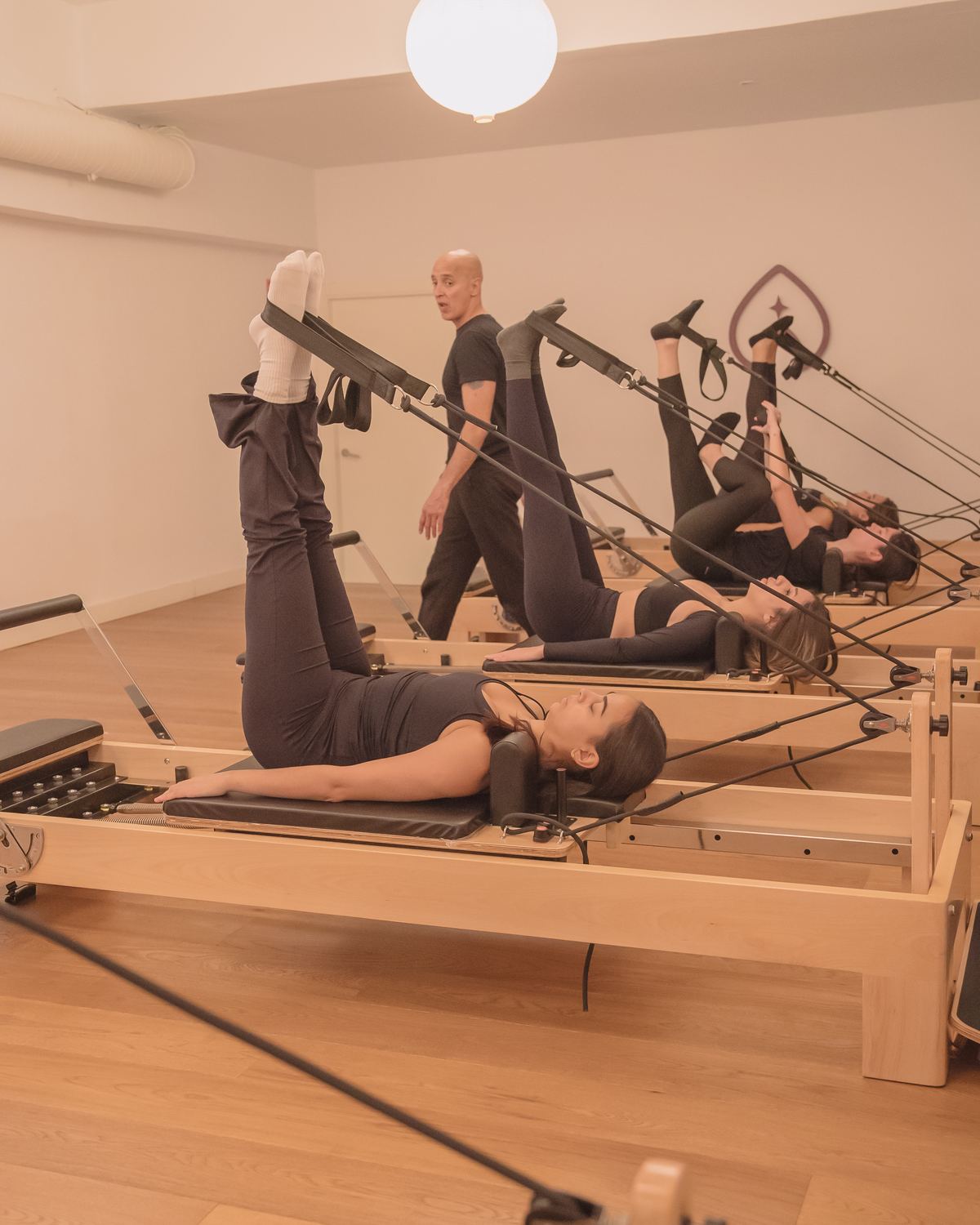
There is a widespread idea about Pilates that is worth clearing up from the start: that it is a method focused exclusively on the core and the legs. It is understandable that the perception exists. The most common images of Reformer Pilates show abdominal work, Footwork on the footbar or lower-body exercises. But the Reformer’s upper-body repertoire is extensive, systematic and, for many people, one of the most effective tools for building strength and tone in the arms, shoulders and back.
If you have ever wondered whether Reformer Pilates can give you more toned arms without your muscles growing disproportionately bulky, or if you are looking for something that corrects the posture that office work wears down, this article gives you the answers.
Why the Reformer Is Effective for the Upper Body
Reformer Pilates does not work the arms the way a conventional gym does. There are no dumbbell biceps curls or shoulder presses on a guided machine. The Reformer trains the upper body within complete chains of movement, which means the muscles of the arms and shoulders always work in coordination with core stabilisation, the position of the shoulder blades and the alignment of the spine.
The Reformer’s spring system provides resistance that can be adjusted precisely throughout the whole range of joint movement. That lets you work the muscles in a functional range, without the load peaks that cause excessive muscle fatigue or the joint overload that often appears in free-weight work when technique fails.
The result, with regular practice, is not visible muscle hypertrophy but what the Pilates method describes as long, toned muscles: more definition, better neuromuscular control and a posture that reflects the work done.
What Many Women Are Looking For and How the Reformer Delivers It
One of the most frequent concerns among students joining classes at Pinar Pilates is not wanting their arms to get bulky. It is a legitimate concern and it has a clear physiological basis: developing significant muscle hypertrophy requires a combination of high load, high training volume and, in most cases, hormonal conditions that women with typical oestrogen levels do not usually have.
The Reformer works with moderate resistance and a number of repetitions that stimulates muscular endurance and coordination, not growth in fibre thickness. The effect on the arms is toning: the muscles gain tension, definition and control, but not mass. The result looks more like the arm of a swimmer or a rower than that of someone who trains with maximal loads.
In addition, Reformer work always includes an eccentric stabilisation component: the muscles brake the movement as well as generating it, which develops a type of strength that isolated concentric exercises do not achieve. This eccentric work is one of the factors behind the long, defined look that characterises regular Pilates students.
The Upper-Body Repertoire on the Reformer
The Reformer straps are the central element of arm work. Hanging from the rear risers, they allow multiple load configurations and an enormous variety of exercises. Added to these are push-ups on the moving carriage, prone work with the leather straps and kneeling exercises that combine stabilisation with arm movement.
Below we describe the most-used exercises in the upper-body repertoire, ordered from least to most demanding.
1. Arms in Straps: Biceps Series
Lying on the back with the feet supported, the student holds the straps with the arms extended towards the ceiling. The action consists of bending the elbows to bring the hands towards the shoulders, keeping the elbows fixed in space and the shoulders actively drawn away from the ears.
Unlike a conventional biceps curl, this exercise requires the core to stay active so the load of the straps does not lift the shoulders off the carriage. The biceps works under controlled resistance through a full range, and the return to the starting position demands eccentric control that dumbbell exercises rarely require to a comparable degree.
2. Arms in Straps: Triceps Series
From the same position, with the elbows bent and pointing to the ceiling, the student extends the arms, pushing the hands towards the hips. The work falls on the triceps, which has to overcome the spring resistance in the extension and control it on the return.
This exercise is especially effective because it works the triceps through its full functional range: from maximum flexion to full extension, passing through the point of greatest spring resistance. The back of the arm, usually the hardest area to work without equipment, is directly involved.
3. Arm Circles with Straps
Also lying on the back, the student traces wide, controlled circles with both arms at the same time, keeping the elbows slightly bent and the shoulders fixed on the carriage. This exercise mobilises the shoulder joint in every plane, works the rotator cuff muscles as dynamic stabilisers and demands bilateral coordination that engages the nervous system differently from linear repetition work.
The circles are performed in both directions and the size of the movement is adjusted to the student’s level. At advanced levels the spring tension is increased and body support is reduced.
4. Pulling Straps (Prone)
Lying face down on the carriage with the head towards the springs, the student holds the leather straps with the arms extended in front. The movement consists of drawing the arms towards the hips while slightly lifting the chest off the carriage, activating extension of the thoracic spine.
This exercise intensely works the latissimus dorsi, the posterior deltoid, the rhomboids and the middle trapezius: the muscles that open the back, retract the shoulder blades and correct rounded, forward shoulders. It is one of the exercises most directly linked to postural improvement, and its effects quickly show in how the student holds their shoulders in everyday life.
To go deeper into the relationship between this kind of work and posture, see our article on improving posture with Reformer Pilates.
5. Chest Expansion
Kneeling on the carriage with the back to the springs, the student holds the straps with the arms extended at the sides and draws both arms back in a controlled movement while keeping the chest open and the spine neutral. The spring resistance acts in the opening phase, and eccentric control happens on the return.
Chest Expansion works the shoulder extensors and the scapular retractors, but its greatest value is probably postural: it forces you to keep the chest open and the shoulders down throughout the movement, a pattern that many people who work at a computer have lost and need to actively recover.
6. Long Stretch: Plank on a Moving Carriage
In this exercise the student takes a plank position with the hands on the footbar and the feet on the carriage, and pushes the carriage back and forth with the feet while keeping the body rigid as a board. The demand on the upper body is enormous: the arms and shoulders support the body’s weight while the carriage moves beneath the feet, which requires shoulder stabilisation under dynamic conditions that no static exercise can replicate.
It is a multilevel-to-advanced exercise that develops real functional strength in the arms, chest and front of the shoulder. The unstable surface of the carriage amplifies the work of the stabilisers. To see more Reformer exercises in context, read our article on Reformer Pilates exercises.
7. Kneeling Arm Work
Kneeling on the carriage facing the springs, the student holds the straps and performs different variations of arm movement, from backward extensions to diagonals and rowing movements. The kneeling position removes the support of the feet on the floor, which forces the core and the hip muscles to stabilise while the arms work.
This exercise combines arm work with a high proprioceptive demand: the carriage can move if the student does not keep their balance, which turns every repetition into a coordination exercise as well as a strength one.
The Link between Upper-Body Strength and Posture
The muscles of the upper body are directly responsible for how we hold our shoulders, neck and thoracic spine throughout the day. When the chest muscles are shortened and the back muscles are weakened, the visible result is the characteristic posture of someone who spends many hours in front of a screen: rounded shoulders, forward head, a stooped upper back.
This pattern does not only affect appearance. It produces chronic neck tension, increases the load on the intervertebral discs of the cervical spine and can lead to problems such as neck pain or shoulder tendinitis. If you have any of these complaints, you can also read our article on shoulder pain and Reformer Pilates.
The Reformer’s upper-body repertoire acts directly on this imbalance: it strengthens the scapular retractors and the shoulder extensors, mobilises the thoracic spine and retrains the activation pattern of the posterior chain. The effect on posture is one of the changes students usually notice first, sometimes from the very first weeks of regular practice.
Progression by Level
One of the advantages of the Reformer over other training equipment is how finely difficulty can be graded. For arm work, progression works in three dimensions:
Spring tension determines the resistance the student has to overcome. More springs mean more resistance in pushing exercises and less in pulling exercises from a supine position (where the springs assist the return). At beginner levels the tension is low; as the student gains strength and control, it is increased.
Body position also grades the difficulty. An arm exercise lying on the back with the feet supported is far more accessible than the same exercise kneeling on the carriage, which in turn is less demanding than the plank position of the Long Stretch.
The number of points of support determines the stabilisation demand. The fewer supports, the greater the demand on the core and the stabilising muscles of the shoulder. This progression means the same exercise can suit a student who is just starting and one with two years of practice, simply by changing the set-up.
If you are thinking about starting, read our guide to the first Reformer Pilates class in Madrid to know what to expect.
Frequently Asked Questions
1. Can Reformer Pilates replace weight training for the arms?
It depends on the goal. If you want to increase muscle mass significantly or build maximal strength, weight training has mechanisms the Reformer does not replicate. But if your goal is toning, definition, functional strength and better posture, the Reformer can be your main upper-body training without needing to add weights. Many students who have swapped weights for Reformer Pilates report a better appearance and less joint tension in the medium term.
2. How long does it take to see results in the arms with Reformer Pilates?
The first changes in perceived firmness usually appear between four and eight weeks of regular practice, with two or three sessions a week. Visible changes in definition and posture are usually noticeable to others from eight to twelve weeks. Consistency is the decisive factor: one session a week produces slower results than two or three.
3. Can I do Reformer Pilates if I have a shoulder injury?
In many cases yes, with the right adaptations. The Reformer lets you work the upper body with very low resistance, in positions that avoid compromised joint angles, and with a control over range of movement that is not possible with free weights. If you have a diagnosed shoulder injury, tell the instructor before you start so they can adapt the exercises. Read more in our article on shoulder pain and Reformer Pilates.
4. Is arm work on the Reformer suitable for beginners?
Yes. The Arms in Straps series is accessible to anyone starting out: it is done lying on the back, with the body fully supported and low spring tension. The instructor introduces the more demanding exercises, such as the Long Stretch or Kneeling Arm Work, progressively as the student gains strength and control. Nobody arrives on day one and does a plank on a moving carriage.
5. What is the difference between arm work on the Reformer and on the mat?
Mat Pilates includes arm work, but with clear limitations: the resistance depends on your own body weight and cannot be adjusted, the positions are more limited and there is not the variety of set-ups that the Reformer’s straps and spring system offer. The Reformer lets you isolate and work specific muscle groups with a precision and variety that mat work cannot match.
The Reformer is not only a machine for the core and the legs. Its upper-body repertoire is one of the most complete and versatile of any training system, and its effects on arm tone, shoulder strength, opening of the back and overall posture are real and documentable within a few weeks of consistent practice.
At Pinar Pilates we work in groups of 8 people maximum with more than 40 classes a week at Calle del Pinar 8, 28006 Madrid (Salamanca district). Our instructors adapt the upper-body work to your level, your goals and any specific condition you need to take into account. More than 490 Google reviews (average 4.9 out of 5) reflect the level of attention every student receives.
You can call us on +34 611 994 729 or book directly through our online platform.
Book your first class at 50% off
Pinar Pilates · Salamanca district, Madrid
Your first reformer class, €15
Groups of 8 people maximum, specialist instructors and more than 40 classes a week. Your first class is half price.
Book my first classCalle del Pinar 8, Madrid · Questions? Message us on WhatsApp